
Reviewed · BOSTON
The Full Revolutionary Story Epic Small Group Boston Walking Tour
Boston’s Freedom Trail is easy to follow, but the American Revolution is not. This tour makes sense of it by telling the story in chronological order, rather than simply marching from one red-brick marker to the next. You begin at City Hall Plaza and finish near Lewis Wharf, passing burial grounds, protest sites, meeting halls, the North End, and Boston Harbor along the way.
I like the way the guides connect famous names such as Paul Revere, John Hancock, Sam Adams, and Benjamin Franklin to the actual streets where their choices mattered. I also like the visual teaching tools, including maps, character cards, and even Lego soldiers for the Battle of Bunker Hill. The main drawback is simple: this is a long walk, often lasting three and a half hours, with much of it outdoors.
Key points to know before you book
- The story follows time, not just geography: You learn how Boston moved from colonial tension to open revolt in a clear sequence.
- The group is capped at 15 people: That gives the guide room to answer questions and keep the discussion personal.
- You see more than the standard Freedom Trail: The route includes Post Office Square, the Financial District, the Greenway, and the Harborwalk.
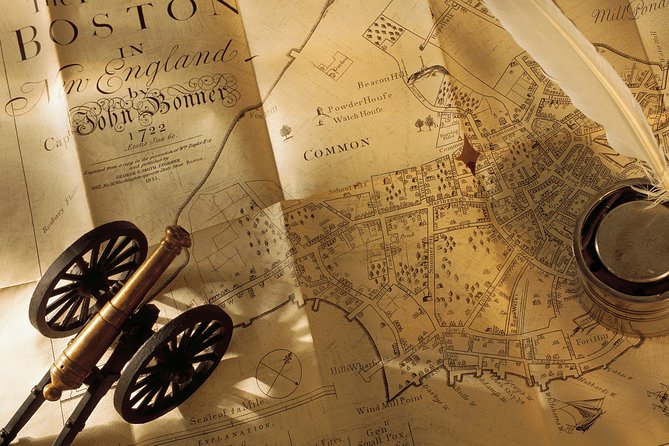
- The teaching is active and visual: Guides use maps, props, and simple demonstrations to explain people, battles, and street layouts.
- The walk ends in Boston’s North End: You finish near Italian restaurants, seafood, pizza, cannoli, public transportation, and the waterfront.
- Good shoes and weather planning matter: Expect a moderate level of walking, outdoor stops, wind, and possible rain or cold.
Why the chronological route works so well
Many Boston history walks trace the Freedom Trail from one end to the other. That is convenient, but it can make the Revolution feel like a pile of disconnected buildings. This experience takes a different approach. It moves around downtown when needed so the political story unfolds in order.
That matters because the Revolution did not begin with Paul Revere’s midnight ride. It grew from religious settlement, political arguments, taxes, street violence, printing, protest, and years of mounting distrust. By the time you reach the best-known scenes, you have the background to understand why they mattered.
The guides are central to the experience. Tyler is described as holding a master’s degree in American history and having worked as a curriculum coordinator. Mike, Chris, and Tom also lead tours, and the strongest descriptions of the experience consistently focus on their energy, clear explanations, humor, and love of teaching.
This is not a costume show or a staged reenactment. It is a serious history walk with an approachable tone. You get names, dates, and political context, but the guide also tries to show the personalities behind the events.
More Walking Tours in Boston
- Boston: Freedom Trail History Small Group Walking Tour
★ 5.0 · 6,450 reviews - Cambridge: Harvard University Student-Guided Walking Tour
★ 4.6 · 3,931 reviews - Harvard University Campus Guided Walking Tour
★ 4.5 · 3,632 reviews
Starting at City Hall Plaza and Boston’s modern center
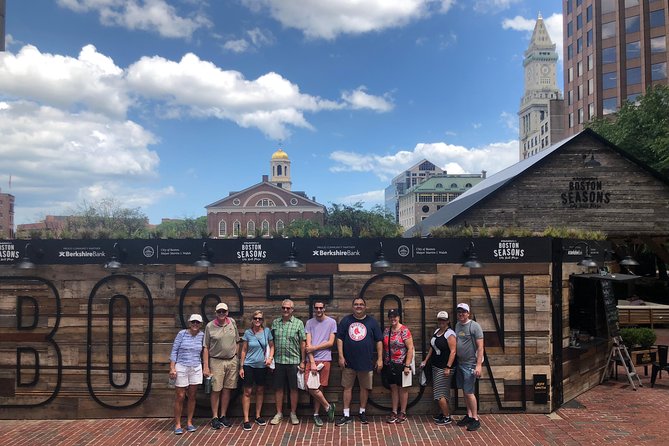
Meet your guide at City Hall Plaza, between Five Iron Golf and the seasonal beer garden, beside the large BOSTON sign. Faneuil Hall appears behind it, so this is a useful place to begin with a photograph and a quick sense of where you are.
The opening stop also makes an important point: Boston is both a historic city and a modern working city. Boston City Hall, with its unusual concrete design, provides a sharp contrast to the brick and stone buildings along the Freedom Trail.
You will not spend long here, but the stop helps frame one of the tour’s themes. The city’s past is not preserved in a sealed museum district. Government offices, restaurants, markets, offices, and public gardens occupy the same streets where colonial arguments once took place.
King’s Chapel and the first burial grounds
King’s Chapel Burying Ground is the first major historical stop. Here, the guide discusses the people who settled Massachusetts Bay and the Puritan culture that shaped early Boston.
This section is useful because it reaches farther back than the usual Revolution story. It gives you a clearer idea of how religion, social rules, local power, and disagreements over authority influenced the colony. The early Puritans are presented as complicated people, not as flat textbook figures.
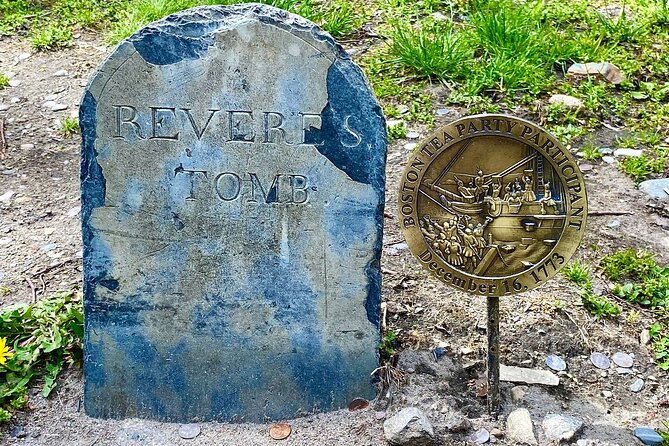
You then pass Boston’s first Anglican church before reaching Granary Burying Ground. The graveyard contains the tombs of Paul Revere, John Hancock, and Sam Adams, among other important figures.
Granary is a compact stop, but it carries a lot of weight. The guide uses the tombs to explain who the Sons of Liberty were and how protest leaders worked within Boston’s tense political world. This is also a place where the tour separates familiar legends from the wider network of people who pushed events forward.
Brimstone Corner and the long road to revolt
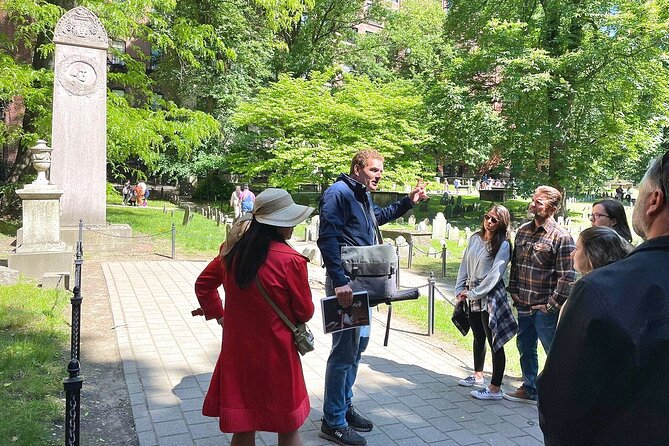
The route includes Brimstone Corner, known for fiery sermons and later connected with William Lloyd Garrison’s first public address against slavery in Boston in 1829. That stop reaches beyond the Revolution and shows how Boston remained a center of public argument long after independence.
This is one of the more useful departures from a basic Freedom Trail walk. You are not only being shown the buildings tied to 1770s events. You are also being reminded that these streets continued to shape debates about democracy, religion, slavery, and public speech.
At Old City Hall, the architecture provides the setting for a discussion of the obstacles and tensions built into democratic government. It is a brief stop, but it connects the city’s past to questions that still matter.
A different sort of day out, same corner of Boston:
- Boston Duck Boat Sightseeing City Tour with Cruise Along Charles River
★ 4.5 · 9,378 reviews - Boston Hop-On Hop-Off Trolley Tour with 13 Stops
★ 4.5 · 5,576 reviews - Boston: City Cruises Whale Watching Cruise
★ 4.5 · 4,710 reviews - Boston Duck Tour: The Original and World-Famous
★ 4.6 · 3,935 reviews
Benjamin Franklin, the Old State House, and the Boston Massacre

The statue of Benjamin Franklin introduces America’s first public school and Franklin’s connection to Boston. This stop works best when you want more than a list of famous founders. Franklin’s life helps show how education, printing, science, and public service fit into the growing political culture of the colonies.
At the Old State House, you reach the political center of colonial Massachusetts. It was the nerve center of local government and a meeting place for arguments over British authority and American rights.
Nearby, the Boston Massacre site brings those arguments into the street. The guide explains the roles of soldiers, citizens, loyalists, and patriot leaders, along with the pressure that turned a tense encounter into a powerful political event.
This part of the walk is especially strong for anyone who wants cause and effect. The tour does not treat the massacre as an isolated tragedy. It places it inside the larger struggle over occupation, representation, public order, and political messaging.
Old South Meeting House and the Boston Tea Party
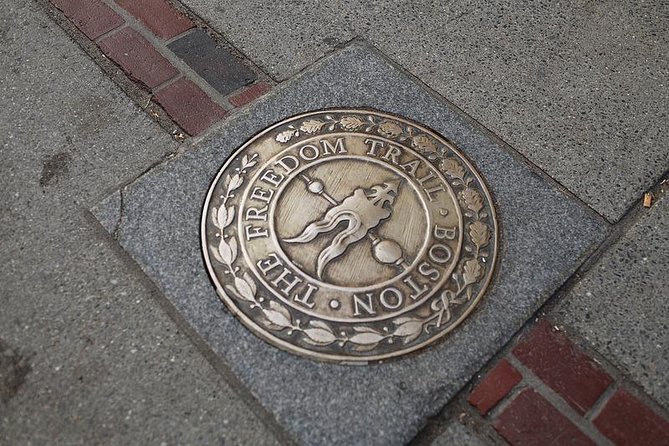
Old South Meeting House marks the point where protest becomes a direct challenge to British power. The Boston Tea Party begins here, with a large public gathering and a decision that made compromise much harder.
You should expect about 15 minutes at this stop. The guide explains why the meeting mattered and how the tea protest became one of the key events leading toward war.
The strength of the presentation is its human scale. You hear about meetings, speakers, crowds, and decisions rather than simply being told that the Tea Party happened. For children and teenagers, this can be the moment when a familiar school lesson begins to feel like something that took place on real streets among real people.
Faneuil Hall, Quincy Market, and the modern city
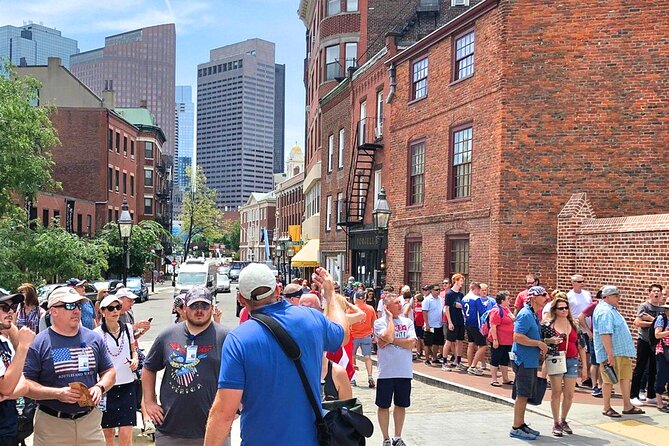
Faneuil Hall is known as the Cradle of Liberty, and the tour uses it to explain how public protest became political action. You get a built-in pause around Faneuil Hall and Quincy Market, which can help break up the long walk.
The market area is also where the guide offers a practical warning: tourist traps are common. Quincy Market is convenient and lively, but it is not automatically the best place for your meal. The advice is helpful because the tour later ends in the North End, where you will have stronger options for pizza, seafood, Italian food, and cannoli.
From here, the route cuts through Post Office Square and the Financial District. This is one of the tour’s best modern touches. You see offices, finance, education, and health care occupying the same central ground where the road to revolution once ran.
The Rose Fitzgerald Kennedy Greenway adds another change of pace. Its public gardens provide a pleasant open stretch through downtown and a reminder that Boston’s present-day public spaces are part of the city’s story too.
Paul Revere’s house and the North End
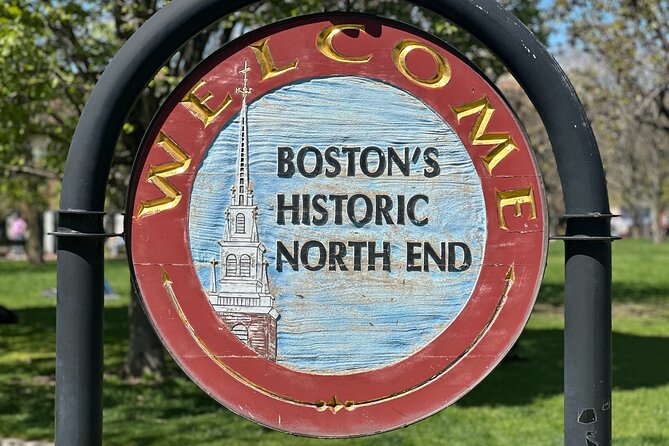
The route then heads toward the North End, Boston’s oldest residential neighborhood. The Paul Revere House sits in North Square, one of the city’s oldest and most charming squares.
The house itself is important, but the surrounding neighborhood adds much of the atmosphere. This is still one of the most enjoyable parts of central Boston for wandering, eating, and looking closely at the street plan.
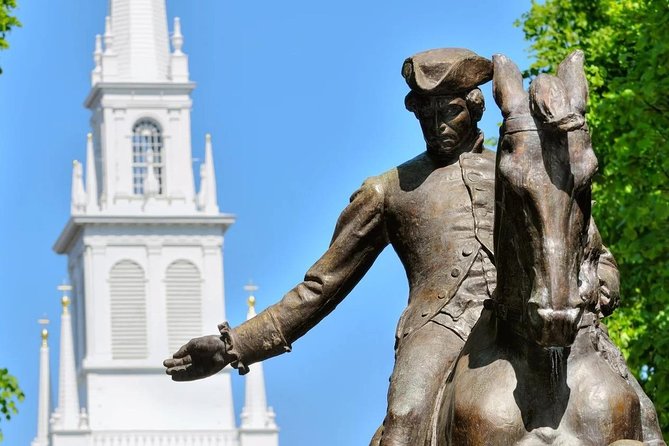
At North Square Park, you learn about the residential world around Revere. The nearby Paul Revere statue offers a natural photo stop before the tour continues to Old North Church.
The North End is also where the guide shifts from formal revolutionary politics to food and neighborhood life. You will hear about Italian restaurants, seafood, pizza, and cannoli. That makes the ending useful beyond history, since your guide can point you toward places to eat after the walk.
Old North Church and the ride toward Lexington and Concord
Old North Church is the setting for Paul Revere’s famous warning system, remembered through one lantern by land and two by sea. From here, the guide takes you through the midnight ride and toward the battles at Lexington and Concord.
You do not need to expect a stage performance. The tour does not reenact the events with costumes. Instead, it uses the church, the street, maps, and spoken explanation to show how the warning moved and why the British march led to open fighting.
This is where the chronological method pays off. You have already heard about the political disputes, street violence, and public protests. Now the armed conflict feels like the result of a long build-up, not a sudden scene dropped into the middle of the walk.
Bunker Hill and the battle explained with simple props
The Bunker Hill portion is one of the most memorable teaching sections. The guide recreates the battle using maps and small visual aids. One guide has used Lego soldiers to show troop movement and the shape of the fight.
That may sound playful, but it serves a real purpose. Battles are hard to understand when you are standing on a city street with no clear view of the original terrain. Small figures and maps can make the sequence easier to follow.
You also get views connected with Charlestown and Boston Harbor. The route includes an exterior look toward another Boston burial ground and a view of the USS Constitution, known as Old Ironsides. The ship was not part of the American Revolution, so the guide explains its later history and offers advice on how to visit it separately.
Boston Harbor and the finish at Lewis Wharf
The final stretch follows the Harborwalk. You get ocean air, waterfront parks, piers, wharfs, and broad views back toward the city.
This ending gives the tour a satisfying physical shape. You begin in the government center, move through the streets where protest grew, pass into the North End, and finish beside the harbor where British forces were eventually pushed out of Boston.
The tour ends at Lewis Wharf, in the North End and close to restaurants and public transportation. Public restrooms, parking, bicycles, and the Aquarium station are nearby. The original meeting point is less than a ten-minute walk away, so you are not stranded at the finish.
How much walking and time to allow
Plan on three to three and a half hours. The distance is not presented as a strenuous hike, but you are on your feet for most of the experience, with frequent stops for discussion.
Wear comfortable walking shoes. Cold wind, rain, and intense weather can affect the experience because the tour takes place outdoors. The company may cancel for poor weather and offer another date or a full refund.
The pace includes short pauses and a break around Faneuil Hall and Quincy Market. Still, this is not the right choice if you want a quick overview in 60 or 90 minutes. It is also less suitable if you have mobility limits that make several hours of city walking difficult.
Children of all ages can attend, but this is not a simplified children’s program. Older children and teenagers who enjoy stories, battles, and questions about government may get the most from it. An adult must accompany children.
Is $55 a fair price?
At $55 per person, the value depends on how much context you want. You are not paying for museum admissions or transportation. The price covers a small group, a long guided route, access around Faneuil Hall and Quincy Market, and a sustained explanation of Boston’s revolutionary story.
I think the price is fair if you would otherwise spend a day trying to connect the Freedom Trail on your own. You see about 14 official landmarks and several additional city spaces, while the guide provides the thread between them.
The value is lower if you only want quick photographs of the major sites. You can walk much of the Freedom Trail independently for free. The reason to book this tour is the interpretation, the chronological structure, the props, and the chance to ask questions in a group of no more than 15.
Who should book this walking tour?
I would choose this experience if you like American history, enjoy a strong storyteller, or want your first day in Boston to have a clear shape. It works well for couples, families with older children, solo visitors, and anyone who wants both colonial history and a look at present-day Boston.
You may prefer a shorter tour if you dislike long explanations or outdoor walking. You should also consider the weather before booking, since the tour requires suitable conditions and has little shelter during most stops.
Should you book it?
Book this tour if you want Boston’s Revolution explained as a connected story rather than a list of famous buildings. The chronological route, small group, visual aids, and North End finish give it more substance than a basic landmark walk.
Skip it if you want a relaxed stroll with lots of free time, indoor exhibits, or minimal walking. For history-minded visitors who can handle three hours on city streets, this is a strong way to get your bearings and understand why Boston became the starting point for so much American political drama.
FAQ
How long is the Full Revolutionary Story Epic Small Group Boston Walking Tour?
The tour lasts approximately three to three and a half hours.
How much does the tour cost?
The listed price is $55 per person.
Where does the tour begin?
It begins at City Hall Plaza, at 1 City Hall Square in Boston. The meeting point is between Five Iron Golf and City Hall, near the seasonal beer garden and the large BOSTON sign.
Where does the tour finish?
The tour ends at Lewis Wharf in Boston’s North End, near the waterfront.
How large is the group?
The maximum group size is 15 people.
Is transportation included?
No. This is a walking tour, and transportation is not included.
Are museum admissions included?
Museum entry is not included, apart from the built-in access around Faneuil Hall and Quincy Market.
Is the tour suitable for children?
Yes. The tour is appropriate for all ages, but children must be accompanied by an adult. It is not designed as a special children’s version of the history.
What physical fitness level is needed?
A moderate level of physical fitness is recommended. You should be comfortable walking outdoors for up to three and a half hours.
Can I cancel for a refund?
You can cancel at least 24 hours before the start time for a full refund. Changes or cancellations made less than 24 hours before the start time are not accepted for a refund. If poor weather or an insufficient number of bookings causes cancellation, you will be offered another date or a full refund.
Just added around Boston
- Boston’s Freedom Trail: A Revolutionary Walking Tour★ 5.0 · 1,343 reviews
- Delicious Donuts of Boston: A Sweet History Walking Tour★ 5.0 · 1,038 reviews
- Narrated Sunset Cruise of Boston Harbor★ 4.0 · 532 reviews
- Sunset Sailing Cruise on a Tall Ship in Boston Harbor★ 4.5 · 414 reviews
- Freedom Trail Walking Tour 250★ 4.5 · 1,118 reviews
- Boston’s North End Food and History Walking Tour★ 5.0 · 459 reviews
- Boston North End Food Tour of 6+ Tastings, Cannoli, Lobster Roll★ 5.0 · 1,404 reviews
- Boston’s North End Food Tour: Italian Flavors & Heritage Walk★ 5.0 · 1,322 reviews
Boston Tours, compared.
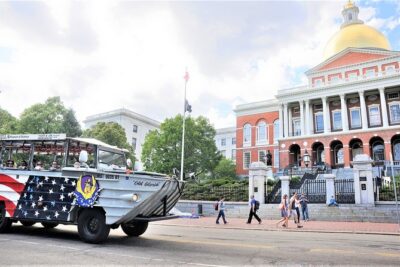
Boston Duck Boat Sightseeing City Tour with Cruise Along Charles River
Read our review →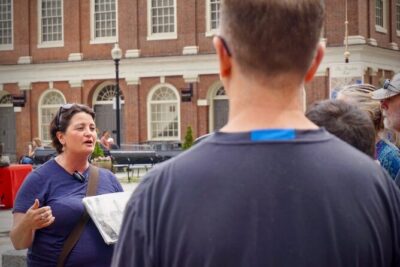
Freedom Trail History Small Group Walking Tour
Read our review →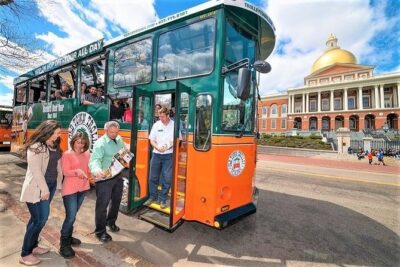
Boston Hop-On Hop-Off Trolley Tour with 13 Stops
Read our review →
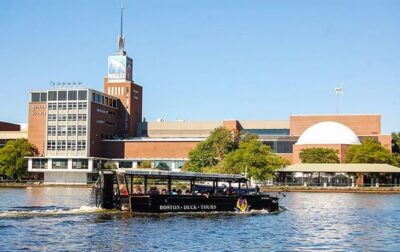
Boston Duck Tour: The Original and World-Famous
Read our review →
Cambridge: Harvard University Student-Guided Walking Tour
Read our review →
Harvard University Campus Guided Walking Tour
Read our review →
Boston Fenway Park: Guided Ballpark Tour with Options
Read our review →Browse the lists this tour appears in