
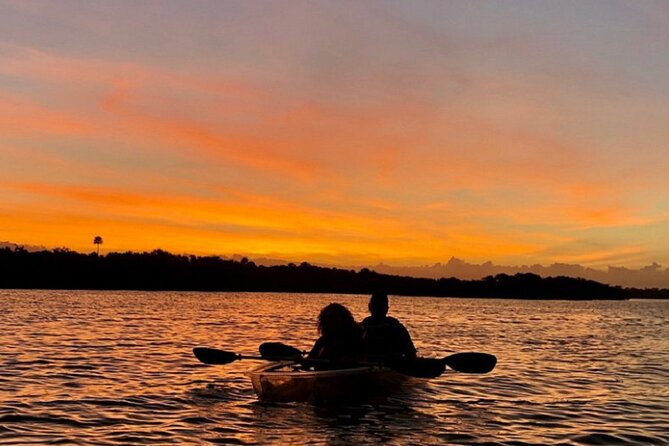
Reviewed · CAPE CANAVERAL
Bioluminescence Kayak Tour
The best part of this Cocoa Beach night tour is the water itself. Stir the lagoon with your paddle or hand and tiny organisms may flash blue-green around you. In cooler months, you may instead see clear comb jellies glowing like small living lanterns. I like the seasonal change in marine life and the way guides such as Matt, Aidan, Caleb, and Zoey add real science to the outing.
I also like that the paddling is gentle enough for first-timers, with a kayak, paddle, and flotation device supplied. The catch is that nature sets the schedule: winter may bring only a few glowing jellies, summer conditions can vary, and local lights may soften the effect.
Key points to know before you go
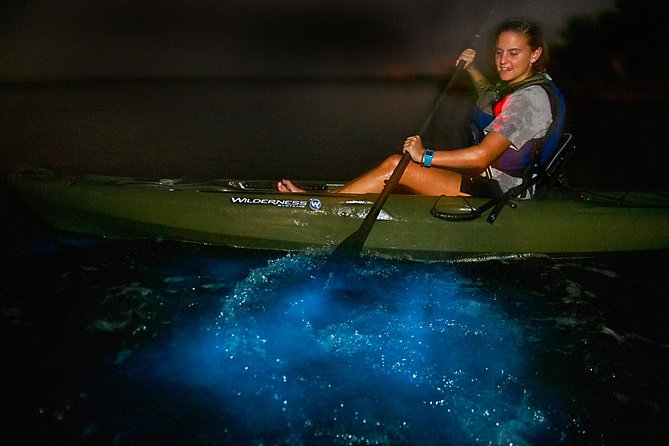
- Two different kinds of glow: Summer usually brings cloudy blue-green dinoflagellates, while winter often brings individual comb jellies.
- A friendly choice for beginners: The tour lasts about two hours, and guides help with getting into the kayak, paddling, and staying with the group.
- Wildlife adds surprises: Fish, jumping mullet, dolphins, and manatees may appear beside the kayaks.
- You may get wet: Wear water-friendly shoes and clothes you do not mind soaking.
- The moon and weather matter: A dark, calm night can improve the experience, while wind, clouds, or nearby lights can reduce the glow.
- The group can be large: Up to 42 people may join, though smaller departures can feel much more personal.
Starting at Kiwanis Island after dark
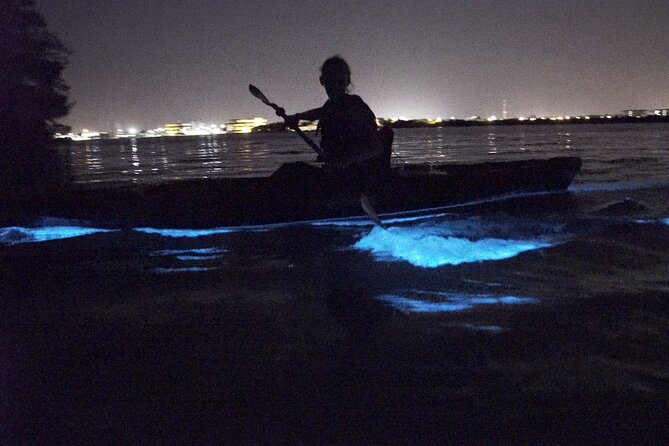
The tour begins at 951 Kiwanis Island Park Road on Merritt Island, just north of Cocoa Beach. You return to this same meeting point after roughly two hours on the water.
Arrive ready to get organized in the dark. You will receive a kayak, paddle, and personal flotation device, plus a safety light from the operator. A flashlight is allowed, but you do not need to bring one. Keep bright lights pointed away from the water once the group gets moving, since they can make it harder for everyone to see faint flashes.
This is not a luxury boat outing. You will be handling your own kayak and paddle, getting in and out near the shore, and working with the rest of the group. The guides give instructions before setting off, and first-time paddlers have been helped through the basics without needing prior kayaking experience.
The maximum group size is 42. That is a sizable group for a quiet nighttime setting, so the experience may feel more like a guided outdoor activity than a private nature trip. Smaller departures can happen, especially outside the busiest periods. If you want the most personal attention, ask about group size before booking.
More Kayak Tours in Florida:
- Clear Kayak Tour of Shell Key Preserve and Tampa Bay Area
★ 5.0 · 5,800 reviews - Rock Springs 2-Hour Glass Bottom Guided Kayak Eco Tour
★ 5.0 · 2,459 reviews - Sarasota Guided Mangrove Tunnel Kayak Tour
★ 5.0 · 2,440 reviews
The first paddle: calm water, mangroves, and night sounds
Once everyone is settled, you paddle into the protected waters around the Indian River Lagoon and Mosquito Lagoon. The route is not described as a long-distance expedition, but the distance can feel greater in darkness, especially if wind picks up.
The water is often shallow and calm. One account described much of it as around 12 inches deep, though conditions can change. Shallow water may help nervous beginners feel more at ease, but you should not treat it as risk-free. Wear the provided flotation device and follow the guide’s directions.
The setting is part of the reward. Mangroves and palm trees line sections of the route, and you may hear more than you see. Fish can dart away from a paddle stroke. Mullet, a local jumping fish, sometimes break the surface with startling speed. Dolphins and manatees are possible, not promised, so consider them an extra gift rather than the main reason to book.
A manatee surfacing beside a kayak can be an impressive moment, but large animals are wild and unpredictable. Give them space, keep your paddle under control, and let the guide handle the group if wildlife appears close by.
How the summer dinoflagellates appear
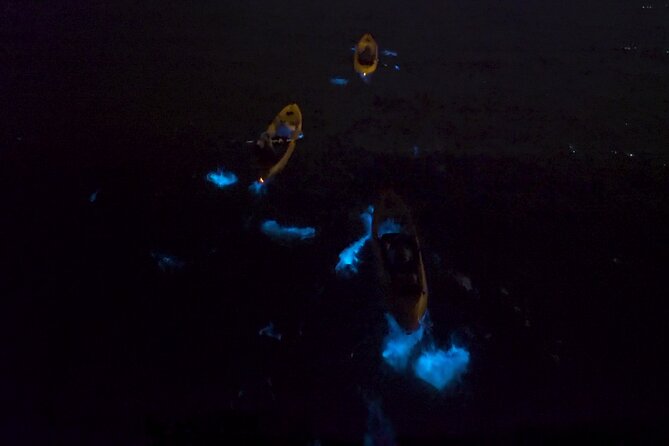
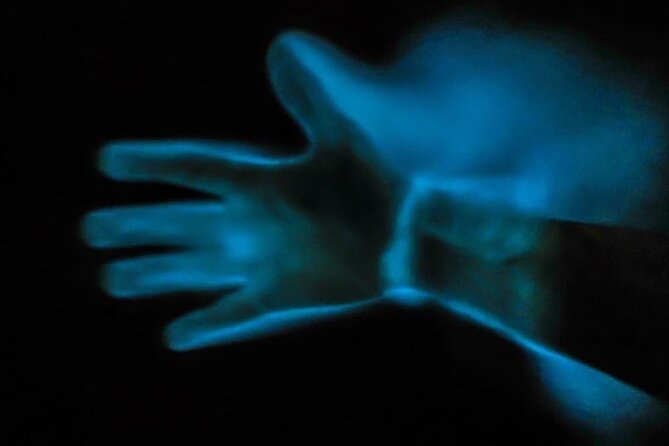
From May through early November, the main attraction is usually dinoflagellate bioluminescence. These are single-celled organisms that emit light when disturbed. Paddle strokes, fish movement, and a hand swished through the water can create a soft blue-green glow.
The effect is not like a bright underwater lamp. Think of scattered sparks or a cloudy glow that appears for a moment and fades. On a strong night, the water may seem to flash around your kayak. On a weaker night, you may see only a few flickers.
This difference matters when you set expectations. The tour operator cannot control the concentration of organisms, water conditions, cloud cover, moonlight, or nearby artificial light. Some summer outings produce an intense display, while others offer a subtler show mixed with ordinary night kayaking.
I like this season best for people who want the classic glowing-paddle effect. It also tends to offer warmer water, which helps if you accidentally splash yourself. You should still wear clothes that can get wet, since even calm paddling can send water into the kayak.
The winter version: gentle glowing comb jellies
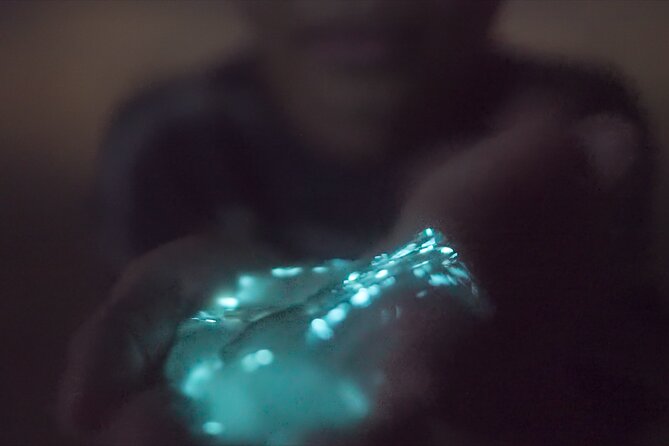
From late November through April, comb jellies become the main attraction. These clear, rounded creatures are not the same as stinging jellyfish. They do not sting, and the tour description says you may catch and hold them carefully.
The experience is more focused than the summer glow. Instead of seeing a broad blue-green cloud around the kayak, you may watch individual jellies shine in your hands or in a net. Guides can point out their movement and explain how these animals fit into the estuary.
Winter trips can be excellent, but they require a little more luck. Some outings produce many comb jellies, while others find only a few. December and January can be especially variable, and one departure encountered little bioluminescence beyond a few glowing animals. The water and air can also feel cold after sunset, so bring an extra layer along with your change of clothes.
A winter trip makes sense if you value the unusual wildlife experience more than a bright water display. Holding a harmless glowing comb jelly is a memorable, hands-on moment, especially for children who can follow instructions and sit safely in the kayak.
A few more Florida days worth weighing up
- Merritt Island: Kennedy Space Center Visitor Complex Ticket
★ 4.7 · 5,637 reviews - Kennedy Space Center: Entry Ticket with Explore Bus Tour
★ 4.7 · 4,670 reviews - Kennedy Space Center with Transport from Orlando and Kissimmee
★ 5.0 · 1,260 reviews - Wizard of OZ Museum tour
★ 5.0 · 1,056 reviews
Guides make the difference
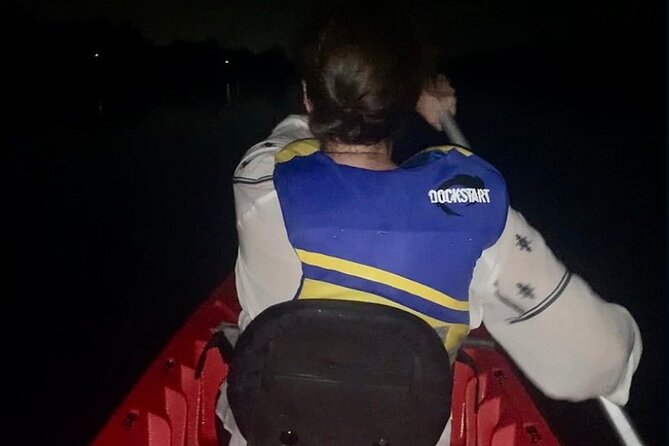
The strongest part of this experience is often the guide. Matt has been praised for explaining the science clearly. Aidan has helped nervous beginners feel comfortable and has kept close watch on the group. Caleb has been noted for explaining local wildlife and adjusting the pace to suit the people in his kayaks.
Zoey has also been singled out for paying attention to energy levels and helping a pair of paddlers when the water became choppy. Sean has brought a strong biology focus, explaining the chemistry behind bioluminescence in a way that appealed even to a teenager who did not want to go kayaking at first. Other guides named during the tours include Jorge, Lucas, Drew, Jordan, Kurt, Kirk, Jessie, and Jackson.
Guide quality can change the feel of the night. A calm, attentive leader makes it easier to relax in the dark. A good guide also keeps the kayaks together, points out movement in the water, and gives useful instructions without turning the outing into a lecture.
Because guides vary, I would not book based on one particular name unless the operator confirms who will lead your departure. Instead, look for a team that explains safety clearly and understands that the glow depends on nature.
Wildlife beyond the glowing water
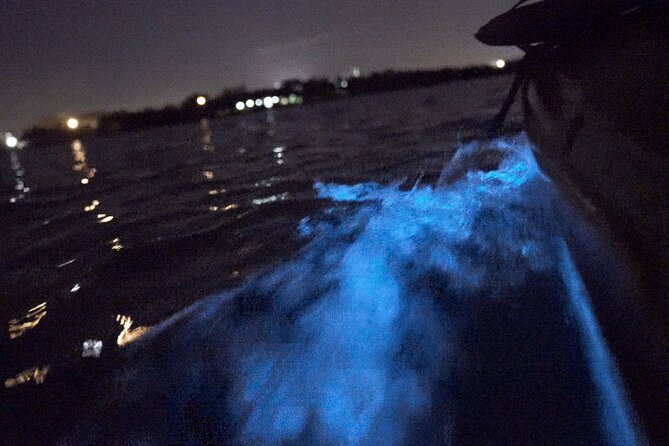
Bioluminescence is the headline, but the lagoon offers more than one attraction. Jumping fish can shoot across the surface like quick flashes. Dolphins may pass by, and manatees may surface near the kayaks. These sightings are never guaranteed, but they help keep the tour interesting if the glow is faint.
You may also notice how quiet the water becomes away from shore. A paddle stroke, a splash, and the sound of another kayak moving through the lagoon can be enough to fill the night. The experience is less about covering ground and more about watching carefully.
On especially clear evenings, the sky can add to the outing. Past departures have coincided with stars, meteor activity, heat lightning on the horizon, and even a rocket launch from Cape Canaveral. These events are pure chance, so do not plan around them. Still, the Cocoa Beach area gives the night a memorable setting beyond the water.
What the two hours actually demand
The paddling is described as low stress, and people without kayaking experience have managed well. You will still need enough mobility to get into and out of the kayak, sit for the tour, and paddle for much of the outing.
Most of the work is steady rather than strenuous. A guide may paddle backward to keep an eye on the group, stop to explain what you are seeing, or adjust the pace. If wind rises, the route can feel harder. One poor experience involved a longer paddle in rougher water, so do not assume every night will be effortless.
Families have brought young children, including a five-year-old, and teenagers have enjoyed the mix of wildlife and science. Children should be comfortable in a kayak at night and able to follow instructions. For older adults, the key question is not age but comfort with paddling, sitting low in a kayak, and handling a wet launch.
What to wear and carry
Wear clothes you do not mind getting wet. A towel should stay in the car, and an extra outfit is a sensible backup. Water shoes, sandals, or Crocs that can get wet are better than ordinary sneakers.
Bring bottled water and snacks if you need them. A dry bag and camera are optional, but ordinary cameras usually do not capture the faint glow well. They are more useful for photographing your group before or after the darkest part of the tour.
A phone camera may record people and the setting, but do not expect it to reproduce what your eyes see. The strongest memories will probably come from watching the glow directly, not from trying to photograph it.
You may bring personal paddling gear, though the kayak, paddle, and flotation device are included. The operator supplies a safety light. Keep extra lights low and use them only when needed.
Timing, moonlight, and light pollution
A dark night can help you see faint bioluminescence, especially during a new moon. Bright moonlight can make it easier to see the surrounding water, but it may reduce the contrast of the glow. This is one reason two departures on the same route can feel very different.
Start time may also matter. An earlier departure could encounter more nearby light, while a later one may feel darker. The exact setting and conditions vary, so ask the guide about that night rather than assuming the latest tour is automatically best.
Nearby lights have affected the experience on some outings. The glow can be difficult to see when the launch area or surrounding shore is bright. This is an important consideration if bioluminescence is your sole reason for booking.
Value, cancellations, and practical limits
No tour price is provided here, so I cannot judge the exact dollar value. The package includes two hours, equipment, a professional guide, and a safety device. That makes it a reasonable use of money if you want instruction, wildlife interpretation, and the chance to see a natural event without bringing your own kayak.
The value falls if you expect a guaranteed spectacle. You are paying for access and guidance in a living estuary, not a staged light show. A strong night can feel extraordinary. A weak night may feel like a pleasant paddle with a few sparks.
Weather can cancel the outing. High wind has stopped at least one departure, and the refund policy says you can cancel up to 24 hours before the start for a full refund. Cancellations made within 24 hours are not refundable, and changes in that period are not accepted. Confirm the meeting details before setting out, since the exact location information should be checked with the operator.
Who should book this Cocoa Beach night paddle
I would recommend it to:
- Families with children who can follow water-safety directions
- Couples looking for an unusual evening activity
- First-time kayakers who want instruction and a calm route
- People interested in marine biology and local estuaries
- Visitors combining Cocoa Beach with Kennedy Space Center or other Cape Canaveral activities
- Anyone willing to accept that wildlife and glowing water cannot be guaranteed
I would think twice if you dislike getting wet, sitting in a kayak for two hours, or being outside after dark. I would also avoid booking it as your only planned highlight if your schedule cannot handle a weather cancellation or a night with little visible glow.
Should you book the Bioluminescence Kayak Tour?
Yes, if you treat it as a nighttime wildlife outing with a chance of bioluminescence rather than a guaranteed light show. The best departures combine calm water, a dark sky, an engaging guide, and plenty of glowing organisms. Even on a quieter night, you may see jumping fish, a dolphin, a manatee, or a few comb jellies.
For the brightest blue-green effect, aim for the May to early November season. For the chance to hold harmless glowing comb jellies, choose late November through April and bring warmer clothes. Ask about wind, light conditions, the expected wildlife, and the meeting point before you leave.
The tour is worth booking for curious, flexible people who want something different from a standard Cocoa Beach attraction. Just let nature have the final word.
FAQ
How long is the bioluminescence kayak tour?
The tour lasts approximately two hours and ends back at the meeting point.
Where does the tour begin?
The meeting point is 951 Kiwanis Island Park Road, Merritt Island, Florida 32953.
What type of bioluminescence can I see?
From May through early November, you may see the cloudy blue-green glow of dinoflagellates. From late November through April, you may see individual glowing comb jellies.
Can I hold the comb jellies?
In the winter season, the tour information says you may catch and hold the gentle comb jellies. They do not sting.
Is kayaking experience required?
Most people can participate, including first-time kayakers. Guides provide instructions and help with the activity, but you still need to paddle and get in and out of the kayak.
What equipment is included?
The tour includes a kayak, paddle, personal flotation device, and professional guide. A safety light is also provided.
What happens if I need to cancel?
You can receive a full refund if you cancel at least 24 hours before the start time. Cancellations or changes made less than 24 hours before the experience are not accepted for a refund.
Just added around Florida
- Key West: All-Inclusive Watersports Adventure with Lunch & Beer★ 4.5 · 351 reviews
- Sunset Sail in Key West with Beverages Included★ 5.0 · 907 reviews
- The Original Key West Island Jet Ski Tour from Barefoot Billy’s★ 5.0 · 350 reviews
- Key West Rum and Reggae: Reef Snorkel Adventure and Sunset Sail★ 4.5 · 370 reviews
- The Dark Side of Key West Ghost Tour★ 4.5 · 334 reviews
- Key West Ultimate Watersports Adventure with Snorkeling Upgrade★ 4.5 · 436 reviews
- Shallow Water Snorkeling and Dolphin Watching in Key West★ 4.5 · 465 reviews
- Key West Small-Group Sunset Sail with Wine and Hors d’oeuvres★ 5.0 · 1,366 reviews
Cape Canaveral Tours, compared.

Merritt Island: Kennedy Space Center Visitor Complex Ticket
Read our review →
Kennedy Space Center: Entry Ticket with Explore Bus Tour
Read our review →
Kennedy Space Center with Transport from Orlando and Kissimmee
Read our review →
Mangrove Tunnels, Dolphins, Manatee Tour #1 Rated in Cocoa Beach
Read our review →
From Orlando: Kennedy Space Center Trip with Transport
Read our review →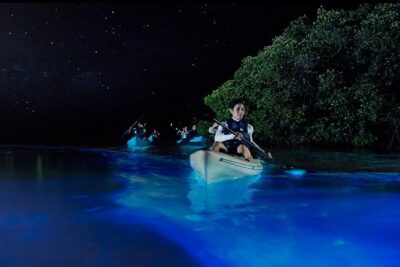
Bioluminescence Night Kayaking Tour of Merritt Island Wildlife Refuge
Read our review →Browse the lists this tour appears in