
Reviewed · MAUI
Maui: Two Hour Beginner Group Surf Lesson in Kihei
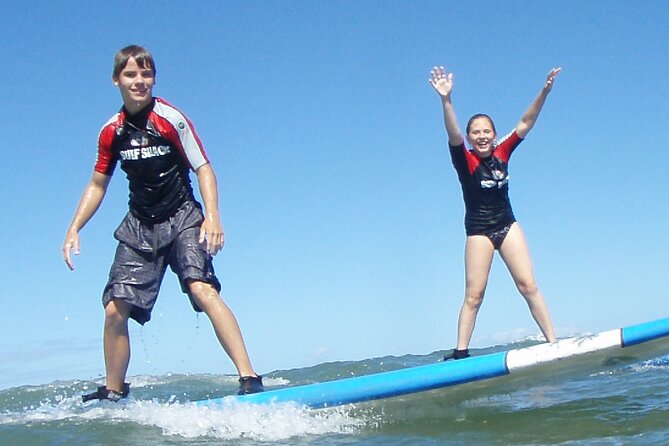
Standing on a surfboard for the first time is the big payoff here, and this lesson is built to get you there quickly. You begin with a short beach tutorial, then head into the water with an instructor who helps position your board and choose manageable waves. The promise is simple: get surfing in one lesson or receive your next lesson free.
I like the small groups of no more than six, since that gives you more chances to ask questions and try again. I also like that the price includes the board, rash guard, water booties, professional instruction, taxes, and the state ocean stewardship fee. The main drawback is that wave conditions can be modest, and Kihei can feel crowded when several surf schools are using the same area.
Key points to know before you book
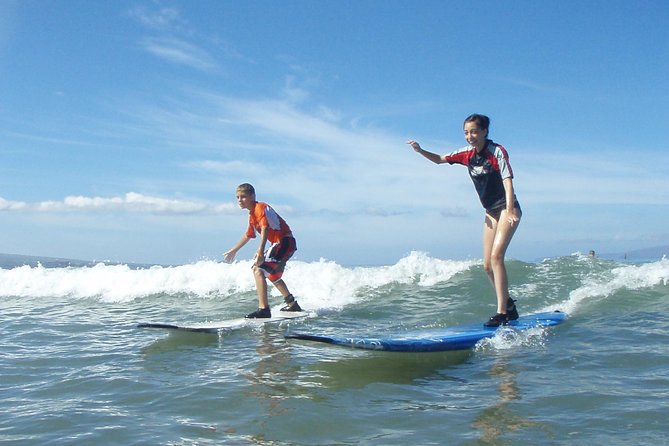
- You get a maximum six-person group, with personal help instead of a large beach crowd.
- The lesson covers safety and etiquette first, then moves into paddling, standing, and catching small waves.
- Boards, rash guards, and water booties are included, so you do not need to rent basic gear separately.
- Several instructors receive especially warm praise, including Mike, Ivan, Jay, Francisco, Justo, and Sofi.
- A photographer may be in the water, with photos available for an extra charge.
- The $98 price includes the main equipment and fees, but hotel pickup and photo packages cost extra.
Starting at Surf Shack Maui in Kihei
You meet at Surf Shack Maui, 1976 South Kihei Road, in Kihei. The activity ends at the same spot, and hotel pickup is not included, so plan your own way there and allow time to park and get organized.
The location has practical advantages. Parking is described as convenient, and the shop sits near family-friendly beaches, shops, and a food-truck area. That helps if one person in your party is taking the lesson while others prefer to wait nearby. It also gives you an easy place to get food after two hours of paddling and standing up.
The class is offered in English. Confirmation arrives when you book, and the maximum group size is six people. That limit matters more than it may sound. Surf lessons involve a fair amount of waiting between waves, so a smaller class usually means more turns and more direct correction from the instructor.
More Surf Lessons in Maui:
- Outrageous Surf ScHool Lesson on Lahaina Side
★ 4.5 · 547 reviews - Open Group Surfing Lesson in Waikiki, Hawaii
★ 4.5 · 582 reviews - Los Angeles: Surfing Lesson in Venice Beach
★ 4.8 · 442 reviews
The beach briefing: safety before surfing
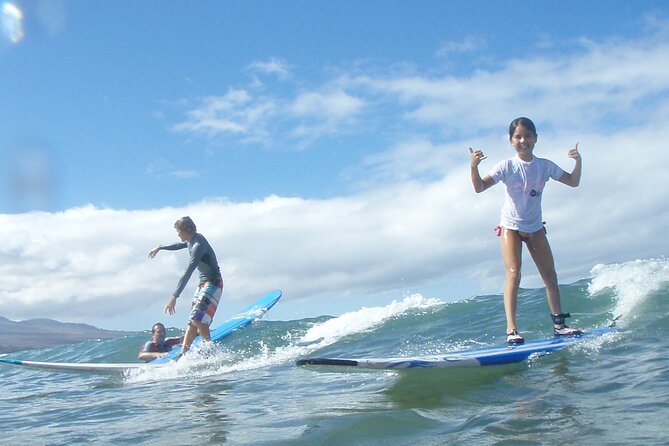
The lesson starts on land with a short demonstration. You learn the basic position on the board, how to get up, how to read the immediate water around you, and what to do when you fall. The instruction also covers surf etiquette, which is not just a formality. Knowing where to paddle, when to wait, and how to avoid another surfer makes the water safer for everyone.
The teaching style is aimed at first-timers. You do not need previous surfing experience, and the lesson is not built around advanced maneuvers. The goal is to help you handle the board, paddle into a small wave, rise to your feet, and stay balanced long enough to enjoy the ride.
This short beach session is useful, but do not expect a long classroom lecture. Most of your two hours are spent in the water. The best advice is to listen carefully during the demonstration, since the same few steps will be repeated again and again once you are wet.
Into the water with a board and rash guard
You receive a surfboard, rash guard, and water booties as part of the $98 cost. The included rash guard helps protect your skin from rubbing against the board, while the booties provide some protection for your feet. One point to keep in mind: the booties have been described as quite thin, so you may prefer to ask the operator about bringing your own if you already have suitable water shoes.
The water near the practice area is shallow enough for beginners to stand after falling off the board, according to the practical details supplied about the lesson. That can make the first attempts feel less intimidating. Still, you should expect an arm workout. Paddling takes effort, and even a successful first ride can leave you tired.
Your instructor helps push or position the board so you can meet the wave at the right moment. That assistance is important for beginners. You are not left to guess when to paddle or which wave to choose. Instructors such as Mike, Ivan, Jay, Francisco, Justo, and Sofi have all been singled out for patience, encouragement, and clear instruction in this setting.
Names and instructors can change by departure, so do not book expecting one particular person unless Surf Shack Maui confirms it. The useful point is that the teaching approach is friendly and hands-on, with instructors adjusting their help to different ages and comfort levels.
Catching your first Kihei waves
The central part of the class is repetition. You paddle, try to stand, fall or ride, then reset for another attempt. That rhythm gives you a real chance to improve within two hours instead of spending most of the session listening on the beach.
Many beginners are able to stand up, sometimes on the first few tries. The lesson has a guarantee that if you do not get surfing in one easy lesson, your next lesson is free. That does not mean every person will ride a long, clean wave. It does mean the company is confident that its method and beginner conditions can get you moving.
Keep your expectations sensible. You are learning to ride small waves, not training for a surf competition. One class can teach you the basic sequence and give you the confidence to keep practicing. It cannot replace hours in the water, especially if your balance, strength, or timing needs work.
Wave conditions are the one part the school cannot control. On calmer mornings, there may be fewer waves to catch, and you might spend more time waiting between attempts. That can be frustrating, but it also gives you a rest between paddles. The instructors continue working with the conditions available, rather than promising a perfect surf day.
The practice area can also be busy. Several groups may be learning at once, so the water may not feel private or empty. For a first lesson, though, the crowd is less important than having a manageable wave and an instructor who keeps you safe.
A few more Maui days worth weighing up
- Maui: 2-Hour Molokini Snorkel Trip
★ 5.0 · 816 reviews - Whale Watching Maui: 2-Hour Small Group Raft Tour from Lahaina
★ 5.0 · 661 reviews - NYC: Circle Line 2h Harbor Lights Cruise Skip-The-Box-Office
★ 4.6 · 8,222 reviews - 2-Hour Exotic Car Driving Experience in Las Vegas
★ 5.0 · 2,870 reviews
What the two-hour schedule really gives you
The advertised duration is about two hours. In one reported session, the class spent roughly an hour and a half in the water after a short beach briefing. That is a useful way to think about the timing: the full appointment includes instruction on land, getting ready, and the active water session.
You should not treat every minute as nonstop surfing. Surfing requires waiting for the right wave, paddling back into position, listening to corrections, and resting your arms. A two-hour lesson still provides plenty of active practice, especially with six or fewer people.
The group format works best for friends and families who want to learn together. You can encourage each other, compare progress, and share the first successful ride. It also suits solo visitors who want a social activity without committing to a private lesson.
Children must be accompanied by an adult. The standard group lesson is for ages nine and older, while children under nine should take a private lesson for safety and for more direct attention. The supplied age notes also say children ages five to nine should book privately, so families with younger children should confirm the correct option before reserving.
Instructors who make the lesson work
Surf instruction depends heavily on the person in the water with you. The most praised part of this class is the teaching. Mike is repeatedly described as encouraging, fun, and good at helping beginners catch waves. Ivan is noted for clear instruction and close attention, while Jay is praised for keeping the morning upbeat.
Francisco, also called Fran, is described as helping a parent and child get riding quickly. Justo and Sofi have been praised for patience, and Micky or Mikey appears in several comments as an instructor who gives calm, useful guidance. Names may be spelled differently or vary by class, but the pattern is clear: the instructors focus on making the first attempt feel safe and achievable.
That matters for older beginners, too. One participant in their sixties was able to try surfing with help from the instructors. You still need a reasonable level of mobility and comfort in the ocean, but you do not need to arrive athletic or experienced.
The class is also well suited to teenagers. The instruction gives them enough basic skill to keep surfing on their own if they choose to rent gear later. For younger children, adults should weigh the group format against the extra attention of a private session.
The optional photographer and the cost of memories
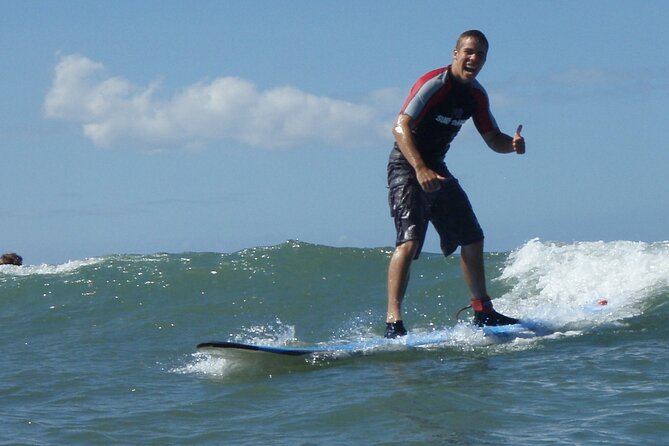
A photographer may be working in the water during the lesson. This can be a nice extra because your first ride is difficult to watch from inside the wave. The photographer may also take posed shots, giving you more than a blurry phone picture from the beach.
Photos are not included in the $98 price. The supplied pricing examples list $40 for one photo or $75 for all the images, with one package providing about 20 pictures. Prices can change, so confirm the current amount before deciding.
I would treat the photos as optional, not part of the lesson’s core value. If this is a family milestone or your first time surfing, the package may be worth considering. If you are mainly interested in learning, you can skip it and still receive the full instruction and equipment package.
Is $98 a fair price?
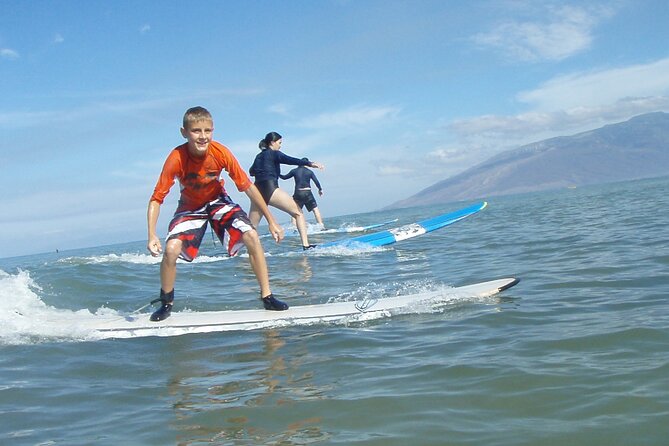
At $98 per person, this is not the cheapest casual activity in Maui, but it includes the items that can quickly add up elsewhere: a surfboard, rash guard, water booties, professional instruction, taxes, and the $1 state ocean stewardship fee. The group is capped at six, which improves the value compared with a large introductory class.
The free follow-up lesson guarantee also reduces some of the risk for a first-timer. You are paying for instruction rather than simply renting a board and hoping to find a wave. That distinction matters in surfing, where a few basic corrections can make the difference between repeatedly falling and getting upright.
Hotel transport is not included. If you are staying outside Kihei, add the cost and time of getting to South Kihei Road. Photos are extra as well. Once you count those possible additions, the class is best value for someone who wants instruction and a real chance to stand up, not someone who only wants a board for casual beach use.
Practical preparation for a better first lesson
Wear or bring a swimsuit that stays secure while paddling and standing. The rash guard is supplied, but you will still want comfortable swimwear underneath. Bring anything you normally need for sun protection and hydration, though the supplied information does not list extra personal items as included.
Arrive ready to work. Paddling can tire your shoulders and arms, and getting up repeatedly takes effort. If the ocean is calm, you may have longer rests between waves, but the class still involves physical activity.
Listen closely to the beach demonstration. The fastest way to improve is to remember the instructor’s sequence for lying on the board, paddling, placing your hands, and standing. You will have several attempts, but each attempt is more useful when you apply the correction from the previous one.
Do not judge the entire lesson by the first fall. Beginners often need several tries before their timing makes sense. The instructors are there to push the board, select manageable waves, and help you understand what went wrong.
Free cancellation is available if you cancel at least 24 hours before the start time. Cancellations within 24 hours are not refunded, and changes in that period are not accepted. The cut-off uses local Maui time.
Who should book this Kihei surf lesson?
Book it if you want a structured first taste of surfing, especially if you are traveling with family or friends. The small group, included equipment, and active coaching make it easier than trying to teach yourself from shore.
It is also a good choice for older beginners, teenagers, and adults who have always wanted to try but felt unsure. You do not need to be an expert athlete, but you should be comfortable taking instruction, paddling, falling into shallow water, and making repeated attempts.
Consider a private lesson instead for children under nine, or for anyone who needs close one-to-one support. You may also want a private option if you dislike crowded practice areas or want a slower pace.
Should you book it?
I would book this lesson if standing up on a surfboard is one of your Maui goals. The six-person limit, included gear, friendly instructors, and free second-lesson promise give it strong value for a first attempt.
Go in expecting a fun introduction, not a polished surf career in two hours. Waves may be small, the practice area may be busy, and your arms may be tired by the end. But with a little patience, this is a practical way to turn a long-held wish into a real first ride.
FAQ
Where does the surf lesson meet?
You meet at Surf Shack Maui, 1976 S Kihei Road, Kihei, Hawaii 96753.
Where does the activity end?
The lesson ends back at the meeting point at Surf Shack Maui.
How long does the surf lesson last?
The lesson lasts approximately two hours, including the beach instruction and time in the water.
How many people are in each group?
The group is limited to a maximum of six students.
What equipment is included?
The price includes a surfboard, rash guard, and water booties, along with professional instruction, taxes, and the $1 state ocean stewardship fee.
Is hotel pickup included?
No. Hotel pickup and drop-off are not included.
What is the minimum age?
The standard group lesson has a minimum age of nine. Children under nine should take a private lesson, and children ages five to nine are specifically advised to book privately.
Can I cancel for a full refund?
Yes. You can cancel at least 24 hours before the start time for a full refund. Cancellations or changes made within 24 hours are not accepted and are not refunded.
Just added around Maui
- Maui: Molokini Crater and Turtle Town Snorkeling From Kihei★ 5.0 · 765 reviews
- Maui: 2-Hour Molokini Snorkel Trip★ 5.0 · 816 reviews
- Maui -PRIVATE- Air Tour FUN: 3 Islands: (2-5 people): SEE it ALL!★ 5.0 · 559 reviews
- Whale Watching Maui: 2-Hour Small Group Raft Tour from Lahaina★ 5.0 · 661 reviews
- Road To Hana: Maui Waterfall Hiking Tour in Private Jeep★ 5.0 · 343 reviews
- Maui Nui Luau at the Sheraton Maui Resort & Spa★ 4.5 · 1,622 reviews
- Myths of Maui Luau Dinner and Show★ 4.0 · 1,144 reviews
- South Maui: Snorkel to Coral Gardens or Molokini Crater★ 4.3 · 689 reviews
Maui Tours, compared.
Small-Group Road to Hana Adventure Tour with Pickup & Lunch
Read our review →

Maui Eco-Raft Tour: Eye-Level Whale or Dolphin Watching – Lahaina
Read our review →
Maui Snorkeling Adventure to Molokini and Turtle Town
Read our review →
Haleakala Sunrise Spectacular with Local Breakfast
Read our review →
Maui Snorkeling Adventure From Ma’alaea Harbor to Molokini
Read our review →

Browse the lists this tour appears in