
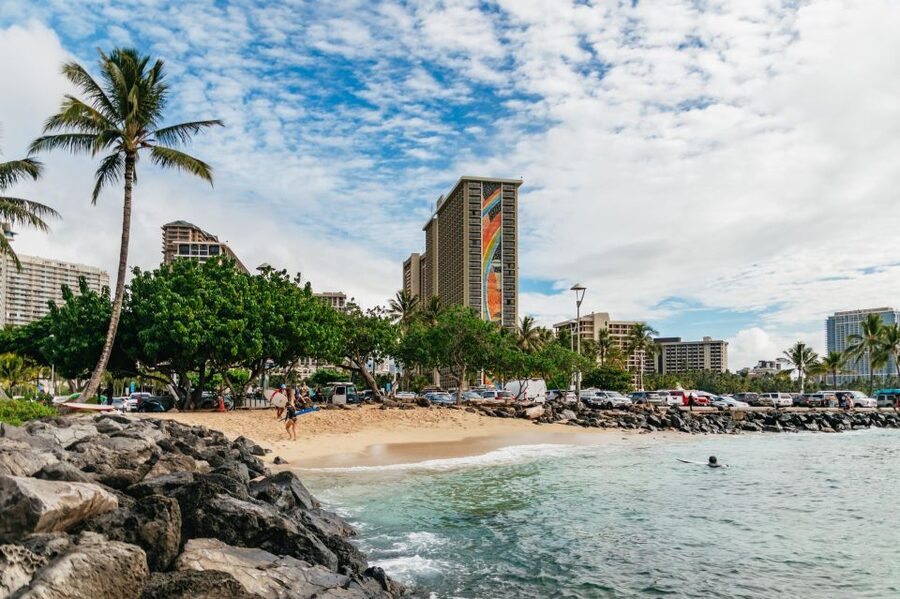
Reviewed · OAHU
Oahu: Beginner-Friendly Waikiki Beach Surfing Lesson
Waikiki is one of the best places in Hawaii to try surfing for the first time, and this lesson gets you onto the water quickly. You spend 20 to 30 minutes on land learning ocean safety and the stand-up motion, then about 70 minutes catching small waves with close supervision. I especially like the one-instructor-for-four ratio and the fact that boards, reef shoes, leash, and rash guard are included. The one catch is that the beach meeting spot can be a little hard to identify, and photos or video cost extra.
I also like the flexible booking terms and the calm, encouraging teaching style reported from instructors including Noah, Kai, Yuko, Mito, John, and Shuji. Some people have had nearly private lessons when bookings were light. Still, this is a real ocean lesson, not a guaranteed stand-up success, so expect to fall a few times before your balance improves.
Key points at a glance
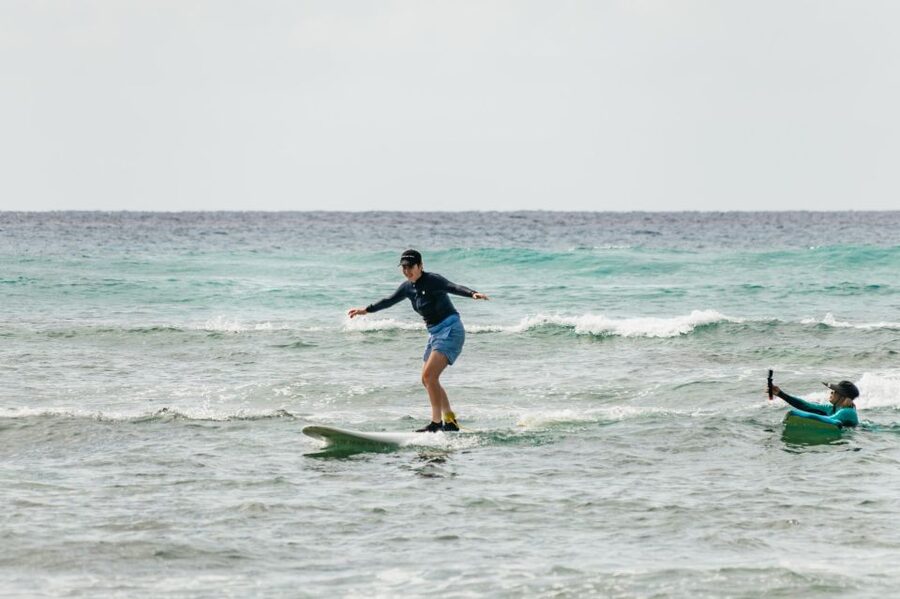
- About 70 minutes in the water: The lesson leaves plenty of time to practice after the beach briefing.
- Small groups capped at eight: The planned ratio is one instructor for every four participants.
- Helpful equipment package: Board, leash, HURLEY rash guard, reef shoes, and an optional wetsuit are included.
- Built for first-timers: The lesson covers ocean safety, board position, and how to stand up before you paddle out.
- Optional action photos and video: Footage is available to buy after the lesson, reported at $45.
- Free oceanfront parking: You meet at Surfer Girl Academy, with parking by the ocean available at no charge.
Why Waikiki is a smart place to learn
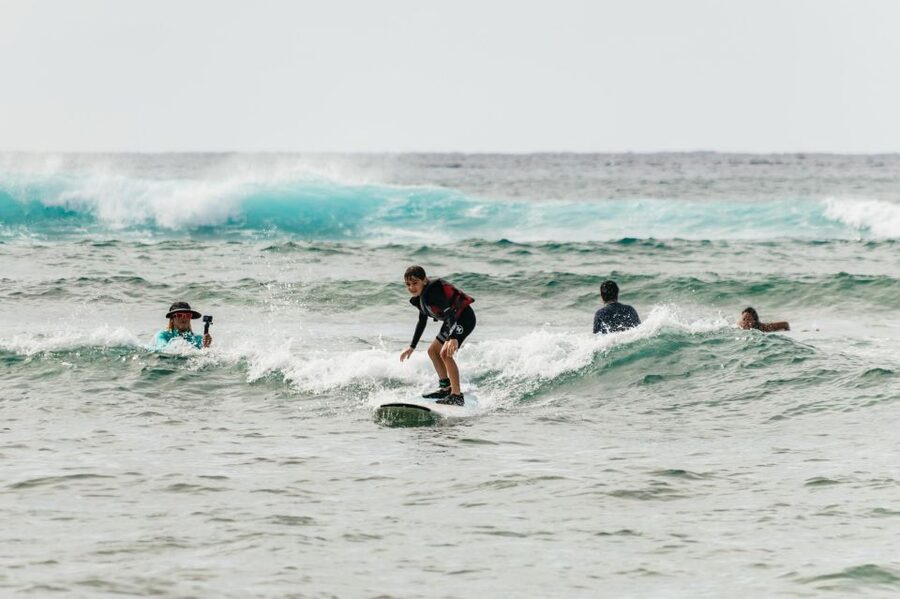
Surfing looks simple from the beach. Lie on the board, paddle, stand, glide. The first attempt usually reveals a different story. Timing, balance, board position, wave direction, and ocean awareness all have to work together.
Waikiki helps because its long shore and famous beginner waves give you a proper introduction without sending you straight into a serious surf break. This lesson takes place in a less crowded section of the beach, according to the activity details, giving you more room to listen, paddle, and recover when things go sideways.
You will not be learning in a swimming pool or on a simulator. You will feel the board move under you, push through the water, and occasionally tip you off. That is part of the appeal. The setting gives you a taste of Hawaiian surf culture while keeping the lesson focused on basic control.
The setting also makes this a good choice for families with older children, couples, and solo visitors who want a guided first attempt. The minimum age is 12, and the activity is not suitable for pregnant women or wheelchair users.
More Surf Lessons in Oahu:
- Open Group Surfing Lesson in Waikiki, Hawaii
★ 4.5 · 582 reviews - Maui: Two Hour Beginner Group Surf Lesson in Kihei
★ 5.0 · 950 reviews - Outrageous Surf ScHool Lesson on Lahaina Side
★ 4.5 · 547 reviews
What happens at Surfer Girl Academy
Your starting point is Surfer Girl Academy. Parking by the ocean is free, which is useful in Waikiki, where parking can otherwise add a noticeable cost to a beach activity.
Allow a little time to find the exact meeting area. One participant found the spot confusing at first, and the beach itself is described as small. If you are unsure, calling the company is sensible rather than wandering around in swimwear with a surfboard in hand.
At the academy, you receive your surf gear. The package includes a board, leash, HURLEY rash guard, and reef shoes. A wetsuit is available if you want one, though the provided information does not say that you must wear it. Bring your own swimwear, towel, sunscreen, water, and a change of clothes.
Cash is also listed among the items to bring. That is worth noting because the activity includes a sticker, but photos and video are sold separately. Having some cash gives you an easy way to handle small on-site purchases, though no exact cash amount is specified.
The beach lesson takes 20 to 30 minutes
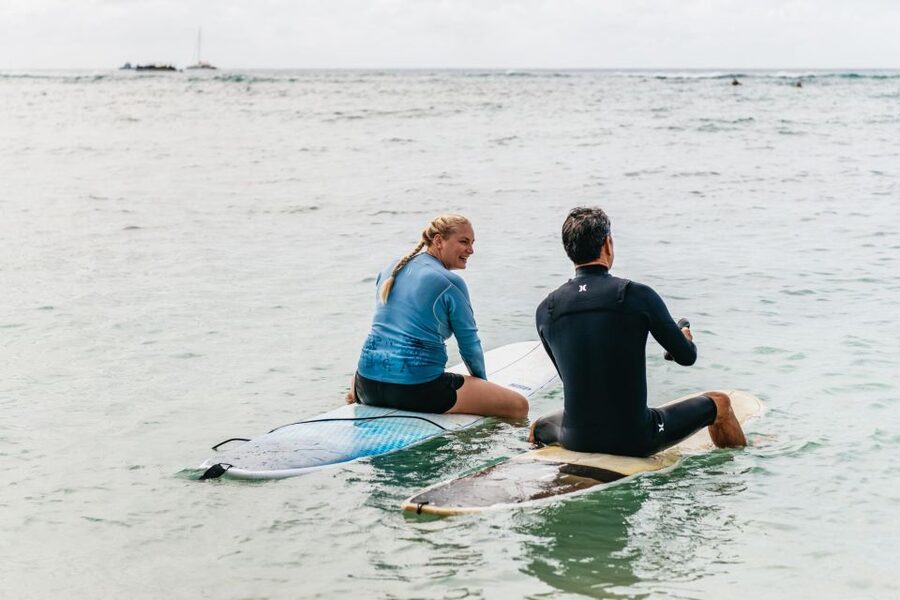
The dry-land session is short enough to keep you from getting restless, but long enough to cover the basics that matter. You learn general ocean safety, how to handle the board, and how to move from lying down to standing.
That stand-up motion is the part most beginners worry about. A good instructor breaks it into steps: place your hands correctly, bring your feet underneath you, keep your balance low, and face the right direction. The point is not to look graceful on the sand. It is to build a movement you can repeat once the board starts moving.
The instructors also explain how to position yourself and follow directions in the water. This matters more than many first-timers expect. A beginner can have decent balance and still miss waves by paddling too early, facing the wrong way, or drifting out of position.
The ocean safety briefing is especially useful because Waikiki is not just a photo backdrop. You need to listen to the instructors, stay aware of your group, and understand what to do if you lose the board or move away from the lesson area.
About 70 minutes catching Waikiki waves
After the land lesson, you head into the water for roughly 70 minutes of supervised surfing. That is a good use of a two-hour booking. You are not spending the whole session waiting for your turn or listening to a long lecture.
The group is limited to eight people, with one instructor planned for every four participants. Actual group size can be smaller. One person had a solo lesson because nobody else had booked that early time, while another small group had two instructors for three participants. You should not assume you will receive a private lesson, but a quiet time slot can produce unusually personal attention.
Instructors help you choose waves, position the board, and get moving at the right moment. Several named instructors received praise for their patience and encouragement, including Noah, Kai, Yuko, Mito, John, Shuji, and Miko. Staff assignments can change, but the pattern is clear: the teaching is meant to be hands-on rather than a quick demonstration followed by free time.
Expect some falls. That is normal, even when the waves are gentle. The useful measure is not whether you stay upright on the first attempt. It is whether you understand more on your fifth attempt than you did on your first.
Many beginners are able to stand and ride at least some waves during the lesson. Some report catching several waves by the end, while others simply gain enough confidence to try again. Your result will depend on balance, fitness, timing, conditions, and how closely you follow the coaching.
A few more Oahu days worth weighing up
- Oahu Grand Circle Island and Haleiwa Tour: 9-Hr Deluxe Experience
★ 5.0 · 17,387 reviews - Oahu: Grand Tour Around Island 16 Locations plus Snorkeling
★ 5.0 · 8,669 reviews - Parasailing Experience in Waikiki, HI
★ 5.0 · 7,692 reviews - Salute to Pearl Harbor Including USS Arizona
★ 4.5 · 7,433 reviews
Why the small group matters
Surf lessons can vary a lot in value. A cheap class with a large crowd may leave you holding a board and watching other people surf. Here, the planned four-to-one ratio gives the instructor a fair chance to watch your position and correct mistakes.
That attention is most valuable after you begin catching waves. On land, the stand-up motion can feel clear. In the water, you may place one foot too far forward, look down, lean back, or paddle at the wrong speed. A coach who sees the problem can give you one useful adjustment before the next wave.
The group limit also helps with confidence. First-time surfers often feel awkward enough without performing in front of a crowd. A group of eight is still social, but it is small enough to feel manageable.
The size is not a guarantee of constant individual coaching. If all eight participants need help at once, the instructors will have to divide their attention. Still, the four-to-one plan is a strong feature for a beginner lesson, especially compared with an open beach rental where you receive no instruction at all.
The instructors make the biggest difference
The equipment gets you started, but the instructor determines how much you get from the two hours. Names that come up in the supplied feedback include Yuko, John, Mito, Noah, Kai, Shuji, and Miko.
John is described as patient and clear, with a knack for helping people stand. Yuko is praised for making nervous first-timers feel comfortable. Mito is associated with both teaching and taking pictures, while Shuji is noted for long surfing experience and careful instruction. Noah and Kai are praised for helping beginners find the confidence to stand for the first time.
Do not read this as a promise that you will be assigned one particular person. Instead, it gives you a useful idea of the academy’s teaching style. You can expect encouragement, repeated demonstrations, help selecting waves, and corrections to your posture.
The best advice is simple: listen closely, even when you are eager to paddle. A short correction about where to place your hands or how to keep your weight centered can save several failed attempts.
Gear, comfort, and what to bring
The included gear removes several small costs and decisions. You receive:
- Surfboard
- Leash
- HURLEY rash guard
- Reef shoes
- Optional wetsuit
- Sticker
Reef shoes are particularly helpful for a first session because they give your feet some protection and confidence around the shore. The rash guard helps protect you from board rub and sun. You still need sunscreen, and you should reapply it as needed.
Bring swimwear, a towel, water, and dry clothes. A change of clothes makes the trip back to your hotel or the rest of your day more pleasant. The provided information also asks you to bring cash, which is worth remembering if you plan to purchase the optional media.
The lesson is physical, though not described as an advanced fitness activity. You will paddle, push up, stand, fall, and repeat the process. Basic balance helps, but the instruction is designed for all surfing levels, including people starting from zero.
Are the photos and videos worth $45?
The lesson includes the chance to buy pictures and video, but the media is not part of the $125 price. The optional package is reported at $45.
That is a meaningful extra cost, especially if you are traveling with several people. On the other hand, surfing is hard to photograph from shore. Your friends may see you stand up, but they cannot easily capture the exact moment you catch a wave from the water.
The academy staff may have a photographer or instructor taking GoPro images and video during the session. Several people found the footage worth buying, especially because it gave them a record of their first successful rides. Others felt the price was a little high.
My practical advice: decide before you go. If you mainly want the lesson, skip the media and keep the $45. If standing on a Waikiki wave is a major vacation goal, the footage may be one of the few clear records you have of it. Bring cash as requested, but confirm the current purchase details on site.
Is $125 a fair price?
At $125 per person, this is not the cheapest way to touch a surfboard. You could rent equipment for less, but rental savings come with a tradeoff: you must figure out wave timing, board control, and safety on your own.
Here, the price includes a two-hour session, the board and safety gear, reef shoes, a rash guard, a planned small group, and direct instruction. The useful part is not just the equipment. It is having someone put you in the right place, point you toward a manageable wave, and tell you what to change after you fall.
The value is strongest for a first-timer who wants a real chance to stand up. It is also sensible for a parent who does not want to manage surfboards and ocean safety alone.
The value is weaker if you already surf comfortably. A more experienced surfer may prefer independent rental time. Still, the activity is open to all skill levels, so a beginner who has tried once before could use it to correct basic habits.
The reserve-now, pay-later option gives you some flexibility, and cancellation is free up to 24 hours in advance for a full refund. Check available starting times because the total session lasts two hours.
Who should book this Waikiki lesson?
I would choose this lesson if you fit one of these profiles:
- You have never surfed and want clear instruction before getting into the water.
- You are nervous about trying a board alone.
- You want a small group instead of a crowded beach class.
- You are visiting Oahu with family members age 12 and older.
- You want the chance to buy action footage of your first waves.
- You prefer a planned lesson over renting a board and guessing what to do.
I would think twice if you need wheelchair access, are pregnant, or are looking for a quiet beach activity with little physical effort. I would also avoid booking back-to-back plans immediately after the lesson unless you have time to change and dry off.
The lesson is available in English and Japanese. That may help you choose it if either language makes instructions easier to follow.
Practical details for a smooth morning
Wear swimwear under clothes that are easy to change. Pack sunscreen, water, towel, and a dry outfit. You do not need to bring a surfboard, leash, rash guard, or reef shoes because those are included.
Arrive with enough time to locate Surfer Girl Academy. The free oceanfront parking is convenient, but the meeting area has caused some confusion, and the beach is small. If you do not see the group, call the company rather than assuming you are at the wrong Waikiki beach.
Do not book this as a last-minute filler if you have a tight schedule. The advertised duration is two hours, and the water portion alone lasts about 70 minutes. Add time for changing and getting settled.
Finally, keep your expectations sensible. A first lesson can produce a thrilling stand-up ride, but it can also produce several tumbles and only brief glides. The goal is to leave knowing how to continue, not to become an accomplished surfer in one morning.
Should you book it?
Yes, if your goal is a friendly and well-supported first surf lesson in Waikiki. The strongest reasons are the small group, included gear, focused land briefing, and roughly 70 minutes of real practice. The repeated praise for patient instructors such as Yuko, John, Mito, Noah, Kai, and Shuji also points to a teaching-first operation.
At $125, you are paying for guidance and a better chance of catching a wave, not just for board rental. Add the optional $45 media package only if having photos and video matters to you.
Book it if you are at least 12, comfortable entering the ocean, and ready to fall a few times. Skip it if you need accessibility features, cannot handle a physical lesson, or already surf well enough to manage your own session.
FAQ
How long does the Waikiki surfing lesson last?
The activity lasts two hours. About 20 to 30 minutes takes place on land for basic instruction and ocean safety, followed by roughly 70 minutes of supervised surfing.
Is the lesson suitable for complete beginners?
Yes. The lesson is designed for all surfing levels, including people with no prior experience. Instructors explain how to stand on the board, help with wave selection, and provide support in the water.
How many people are in each group?
The group is limited to eight participants. The planned teaching ratio is one instructor for every four people, though the actual group can be smaller depending on bookings.
What equipment is included?
The price includes the surfboard, leash, HURLEY rash guard, reef shoes, and a wetsuit if you choose to use one. A sticker is also included.
Are photos and videos included in the price?
No. Photos and video can be purchased separately after the lesson. The price reported for the media package is $45.
Where do I meet the instructor, and is parking available?
Meet at Surfer Girl Academy. Parking by the ocean is free, though the exact meeting spot can be difficult to identify, so call the company if you are unsure where to go.
Just added around Oahu
- Waikiki Starlight Luau on The Great Lawn-Hilton Hawaiian Village★ 3.5 · 374 reviews
- WWII Pearl Harbor Heroes Deluxe Tour★ 4.5 · 621 reviews
- Ultimate Pearl Harbor Circle Island★ 5.0 · 404 reviews
- Tribute to Pearl Harbor Arizona Memorial and Honolulu City Tour★ 4.5 · 733 reviews
- Shared Round-Trip Transfer: Honolulu Airport to Hotel or Cruise Terminal★ 4.0 · 711 reviews
- Shared Arrival Transfer: Honolulu Airport to Hotel or Cruise Terminal★ 3.5 · 609 reviews
- Royal Crown of Oahu – 60 Min Helicopter Tour – Doors Off or On★ 5.0 · 755 reviews
- Oahu: Roundtrip Shuttle From Waikiki to Dole Plantation & Haleiwa★ 4.5 · 561 reviews
Oahu Tours, compared.
Oahu Grand Circle Island and Haleiwa Tour: 9-Hr Deluxe Experience
Read our review →
Grand Tour Around Island 16 Locations plus Snorkeling
Read our review →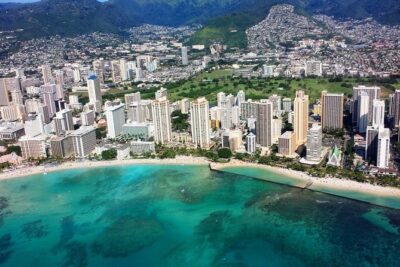

Oahu’s Ultimate Tour: Dole, Turtle Snorkel, Pali Lookout & More
Read our review →
Oahu Circle Island Tour with Turtle Snorkeling— Small-Groups
Read our review →
Browse the lists this tour appears in