
Reviewed · AUSTIN
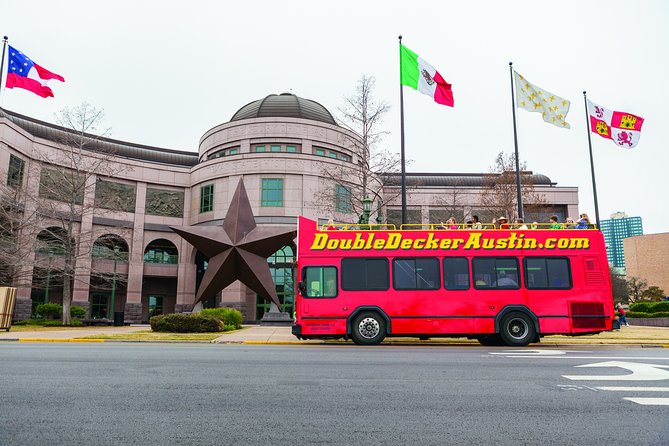
Double Decker Austin Single Loop Sightseeing Tour
Austin’s most useful sightseeing fact is that its main sights spread across several distinct areas. This 75 to 90 minute loop gives you a quick map of downtown, the University of Texas area, South Congress, and Lady Bird Lake without burning your legs on a long walk.
I like the choice between the open-air top deck and the climate-controlled lower deck. I also like the live local commentary, which can turn a simple drive past the Capitol, Driskill Hotel, and Congress Avenue Bridge into a useful first lesson in Austin.
The tradeoff is that this is a panoramic introduction, not a hop-on, hop-off bus. You pass many sights rather than stopping to explore them, and the quality of the narration depends on the guide assigned that day.
Key points to know before you book
- Austin in one loop: See 6th Street, the Capitol, UT, South Congress, Lady Bird Lake, and the Congress Avenue bat bridge in one ride.
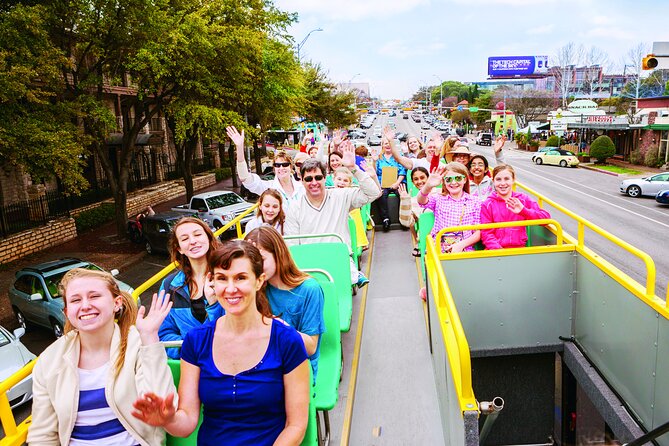
- Two seating options: The upper deck gives you better views and photos, while the lower deck offers shelter and air conditioning.
- Best on your first day: Use the route to decide where you want to return for museums, food, music, and walks.
- Live commentary varies by guide: Jason, Lawrence, Will, and Madi have all been praised for warmth and local stories, though a few passengers found the narration uneven.
- Small group size: The bus holds a maximum of 35 people, which feels more personal than a huge sightseeing coach.
- Weather matters: Sun, heat, wind, rain, and low tree branches can affect the upper deck experience.
Why this Austin bus tour works as an introduction
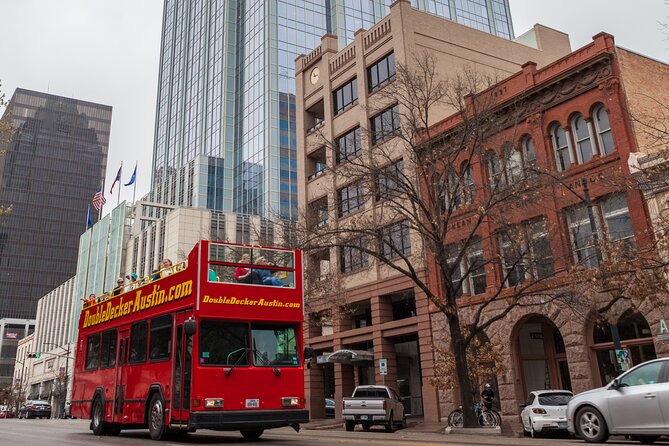
The route does something a first visit to Austin often needs: it links places that do not feel like one compact sightseeing area. You begin near downtown’s east side, pass through the central core and the university district, cross toward South Congress, and return near the city center.
That makes the tour especially useful if you are staying only a few days. I would take it early in the visit, then use the rest of the trip to return to the places that caught your eye. One person described it as a way to make an agenda, which is exactly right.
The tour is also a practical choice if walking long distances is not appealing. Austin can be hot, and the route covers more ground than you could comfortably manage on foot in 75 minutes. The ride lets you rest while still seeing the city’s major landmarks.
The company has a strong overall record, with a 4.7 rating from 979 reviews and 95 percent of customers recommending it. That is a good signal, though not a guarantee of a perfect outing. The most common strength is the guide’s friendly delivery and useful local advice. The main weakness is inconsistency: one guide may fill the drive with stories, while another may leave stretches of the route quiet.
More Bus Tours in Austin:
- Grand Canyon West Bus Tour with Hoover Dam and Optional Skywalk
★ 4.0 · 7,224 reviews - New Orleans City Sightseeing Hop-On Hop-Off Bus Tour
★ 4.5 · 4,943 reviews - Kennedy Space Center: Entry Ticket with Explore Bus Tour
★ 4.7 · 4,670 reviews
Starting at the Austin Visitor Center
The meeting point is listed as 103 E 5th St., at the Austin Visitor Center. The bus loading area is also described as being on Red River Street between 4th and 5th Streets, so check your confirmation for the exact boarding spot.
The visitor center is a handy starting point. It has exhibits, tours, a gift shop, and a travel center, and you can use it as a place to orient yourself before or after the ride. The area is near public transportation, and a parking garage is close by. Street parking may be available, though conditions can change.
Plan to arrive before departure rather than cutting it close. The operator asks passengers to arrive and begin loading about 15 minutes early. The bus generally runs a tight schedule, but a short delay can happen if staff are helping late arrivals.
The maximum group size is 35. That is small enough for the guide’s voice and personality to matter, but large enough that you should not expect a private tour.
Upper deck views or air-conditioned comfort

The upper deck is the main reason to choose a double-decker bus. You get a higher view over cars and low buildings, plus a better angle for photographing the Capitol, the university tower, and downtown streets.
It is also exposed to the weather. Midday heat, strong sun, and wind can make the upper deck tiring. Low tree limbs have caused some passengers to duck, especially along leafy streets. That is a small issue, but it is worth knowing if you are tall or sitting near the outer edge.
The lower deck is the sensible choice on a hot afternoon, during uncertain weather, or if you prefer a quieter, more protected ride. You will lose some of the open views, but the climate control can make the tour much more comfortable.
I would choose the upper deck in mild weather and the lower deck when Austin is hot or stormy. The tour requires good weather, and if poor conditions cancel the trip, you are offered another date or a full refund.
6th Street, downtown, and the Driskill Hotel

The route begins with some of central Austin’s best-known urban sights. Historic 6th Street is the city’s famous entertainment district, lined with bars, music venues, and old commercial buildings. A bus pass gives you a quick sense of its location, but it cannot reproduce the feel of walking the street after dark.
You also pass the Austin Convention Center and the old Central Fire Station No. 1, home to the Austin Fire Museum. The museum covers Austin firefighting from the 19th through the 21st century, with uniforms, photographs, and equipment. It is an easy place to mark for a later visit if local civic history interests you.
The Joseph and Susanna Dickinson Hannig House adds an older layer of Texas history. Susanna Dickinson survived the Battle of the Alamo and carried news of its fall to Sam Houston. The 1869 home was later saved and transferred to the city.
The route also includes the O. Henry Museum, located in the former Austin home of writer William Sydney Porter. You see the outside and hear about his life, but this is not a substitute for a museum visit if you want to go inside.
Then comes the Driskill Hotel, completed in 1886. Its Romanesque design and long history make it one of downtown Austin’s most recognizable buildings. It was built by cattleman Jesse Driskill, who wanted what he called the finest hotel south of St. Louis. The bus gives you the context; you can return later to see the interior at a slower pace.
More Sightseeing Tours in Austin:
- Austin and Hill Country Sightseeing Tour
★ 4.5 · 928 reviews - New York in One Day Guided Sightseeing Tour
★ 5.0 · 13,166 reviews - Boston Duck Boat Sightseeing City Tour with Cruise Along Charles River
★ 4.5 · 9,378 reviews - Miami: Biscayne Bay Millionaire’s Homes Sightseeing Cruise
★ 4.5 · 7,348 reviews
The Texas Capitol and Governor’s Mansion
The Texas State Capitol is the route’s grandest landmark. It is one of the country’s best-known state capitol buildings and has both National Register of Historic Places and National Historic Landmark status.
The bus passes close enough for good views, but this is one place where you may wish the driver could slow down a little more. One useful tip from the feedback is to sit ready with your camera as the bus approaches. If you want to see the building properly, plan a separate visit after the tour.
Nearby, the Texas Governor’s Mansion has served as the official residence of Texas governors and their families since 1856. It is the oldest continuously occupied governor’s residence west of the Mississippi River. The house was badly damaged by arson in 2008, then restored with support from preservation groups, lawmakers, and the public.
These stops give the tour real historical weight, but remember that you are seeing them from the road. The value is in learning where they are and why they matter, not in getting an extended architectural tour.
The University of Texas and its major museums
The route spends a noticeable amount of time around the University of Texas campus. This has been a point of praise for some people and a complaint for others. If you want a broad city overview, the campus section adds variety and helps explain Austin’s identity. If you came mainly for downtown, the university segment may feel long.
You pass Darrell K Royal Texas Memorial Stadium, home of the Longhorns football team since 1924. The stadium has held more than 100,000 spectators and is one of the largest in the United States. Even if you are not a football fan, its size helps explain the importance of college sports in Texas.
The 307-foot UT Tower is another major landmark. Completed in 1937, it is one of the university’s clearest symbols. The bus also passes several important museums and cultural institutions:
- The Bullock Texas State History Museum presents the story of Texas through exhibits and educational programs.
- The Blanton Museum of Art holds more than 19,000 works, ranging from ancient Greek pottery to modern abstract art.
- The Harry Ransom Center focuses on literature, photography, film, art, and the performing arts.
- The Lyndon Baines Johnson Library and Museum presents the former president’s papers, public life, and era.
You will not have time to visit these institutions during the loop. I would treat the drive as a planning tool. The Bullock and Blanton are especially convenient choices if you want indoor activities during a hot afternoon.
The Congress Avenue bats and South Congress
One of the most distinctive parts of the route is the Congress Avenue Bridge. Its underside shelters Austin’s large urban bat colony, with hundreds of thousands to more than a million bats flying out near dusk during the main viewing season, generally April through October.
The bus cannot provide the full bat-watching experience. The point is to learn where the colony is and when to return. If bats are on your Austin list, note the bridge location and plan a separate evening visit.
South Congress, often shortened to SoCo, brings a different mood. This district south of Lady Bird Lake is known for boutiques, restaurants, galleries, music venues, and older homes. It is one of the best areas to revisit on foot because the small shops and street activity are easy to miss from a moving bus.
I like this part of the route because it shows Austin as more than a government and university city. You get a quick look at the places where locals shop, eat, listen to music, and spend time outdoors.
Lady Bird Lake, the Long Center, and the return downtown
The route also takes in Lady Bird Lake and the hike and bike trail. From the bus, you get a sense of how closely Austin’s central districts connect to the water and outdoor spaces.
The Long Center is another useful landmark. It presents music, theater, films, festivals, and other cultural events, and its location near the lake makes it easy to pair with an outdoor walk or another downtown stop.
The return leg may include views of Auditorium Shores, Waterloo Park, Austin City Hall, the Moody Theater, the historic Travis County Courthouse, Moonlight Towers, the Warehouse District, and the Santa Rita No. 1 oil well site. The exact emphasis depends on traffic and the guide’s commentary.
This is also where the tour’s limits become clearest. Austin has too many attractions for a single loop, so some streets and buildings receive only a passing mention. One particularly critical account felt the route focused too heavily on UT and South Congress while giving too little attention to west downtown. I would not book this expecting every district to receive equal time.
The guide makes or breaks the ride
The company uses live commentary rather than a recorded narration. That is a major benefit when the guide is engaged, because you can hear local stories, ask questions, and get suggestions for food and entertainment.
Several guides have earned strong praise. Jason was described as an entertaining local source of recommendations. Lawrence was warm and welcoming, with a clear interest in Austin and Texas history. Will, a British transplant, was praised for his Austin and Texas background. Madi was described as energetic and friendly, though her humor did not suit everyone.
That range matters. Some guides pack the route with facts and jokes. Others may speak too quickly, offer less detail, or apologize for an occasional error. One passenger also felt the tour gave too little attention to African American history and the Barbara Jordan Building. That is a fair reminder that a short general tour cannot cover every part of Austin’s story.
The best approach is to enjoy the commentary as an overview, then follow up on the subjects that interest you. Do not expect a specialist tour in architecture, Black history, politics, music, or the university.
Is $36.81 a fair price?
At $36.81 per person, the tour is not the cheapest way to move around Austin, but it can be good value if you use it as an orientation ride. You are paying for roughly 75 to 90 minutes of transportation, sightseeing, live commentary, and the chance to cover several neighborhoods without arranging separate rides.
The value drops if you want to get off at museums, spend time at the Capitol, or use the bus for transportation between stops. This is a single loop that ends where it began, not an all-day pass.
For a solo visitor, the cost buys an easy first look at a spread-out city. For families, it avoids a long hot walk and gives children the novelty of an upper deck. For repeat visitors, it may be worthwhile if you want a broad refresher or are showing Austin to visiting relatives.
Who should book it?
I would book this tour if you have limited time, want a clear first look at Austin, or prefer seeing a city from a bus rather than walking in the heat. It is also a good choice for families, older visitors, solo visitors, and anyone who wants to mark places for later visits.
I would skip it if you already know central Austin well or want a detailed stop-by-stop tour. The route passes many attractions, and the commentary can vary from excellent to merely adequate. You should also avoid the upper deck during poor weather or very hot afternoons.
Book it for the first day of your Austin stay when possible. Sit upstairs in comfortable weather, listen for restaurant and music suggestions, and keep a note of the places you want to revisit. That is where this tour earns its price.
FAQ
How long does the Double Decker Austin tour last?
The tour takes approximately 1 hour 15 minutes to 1 hour 30 minutes.
Where does the tour begin?
The meeting point is listed as 103 E 5th St. at the Austin Visitor Center. The bus loading area is described as being on Red River Street between 4th and 5th Streets, so check your booking confirmation for the precise boarding location.
Does the tour return to the starting point?
Yes. The loop ends back at the meeting point.
Can I sit on the top deck?
Yes. The bus has an open-air upper deck and a climate-controlled lower deck. Upper-deck seating is more exposed to sun, wind, weather, and low tree branches.
What sights does the route cover?
The route passes sights including 6th Street, the Austin Convention Center, the Austin Fire Museum, the Hannig House, the O. Henry Museum, the Driskill Hotel, the Texas Capitol, the Governor’s Mansion, the University of Texas, the LBJ Library, South Congress, Lady Bird Lake, the Congress Avenue Bridge, and the Long Center.
Is the tour available in languages other than English?
The tour is offered in English.
What is the cancellation policy?
You can cancel at least 24 hours before the start time for a full refund. Cancellations or changes made less than 24 hours before the experience are not refunded or accepted. If poor weather or an insufficient number of bookings cancels the tour, you are offered another date or a full refund.
Just added around Austin
- The Escape Game: Epic 60-Minute Adventures in Downtown Austin★ 5.0 · 358 reviews
- Austin Guided Outdoor Climbing Experience★ 5.0 · 386 reviews
- Austin Small Group Morning Walk★ 5.0 · 412 reviews
- Austin and Hill Country Sightseeing Tour★ 4.5 · 928 reviews
- Austin in a Nutshell Bike Tour with a Local Guide★ 5.0 · 529 reviews
- From Austin: Hill Country BBQ & Wine Shuttle★ 5.0 · 954 reviews
- Austin Electric Bike Tour: Let it Ride★ 5.0 · 892 reviews
- Haunted Austin Walking History Tour★ 4.5 · 921 reviews
Austin Tours, compared.
Best of Austin Small-Group Driving Tour with Local Guide
Read our review →

Austin Food Tour with Local Flavors, Tacos & 6 Food Tastings
Read our review →




Austin in a Nutshell Bike Tour with a Local Guide
Read our review →Browse the lists this tour appears in