
Reviewed · BOSTON
Boston: Freedom Trail History Small Group Walking Tour
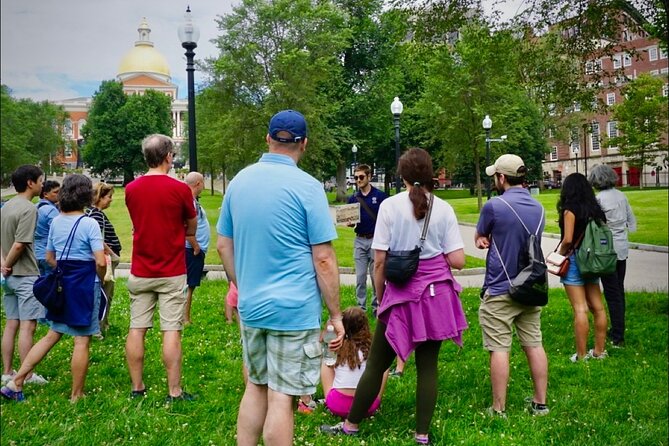
Boston’s Freedom Trail is more than a red line through downtown. It is a compact lesson in how arguments over taxes, soldiers, religion, politics, and power pushed a colonial city toward revolution. This 2.5-hour walking tour covers all 16 official landmarks, with a historian guiding you from Boston Common through the North End.
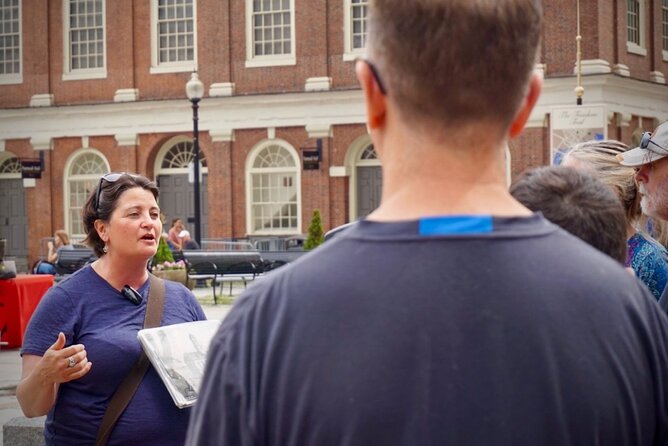
I like the small group limit of 16, which makes it easier to ask questions and hear the guide. I also like the chronological approach used by guides such as Jon, Maura, Mark, and Alejandro. The stories build from early Puritan Boston toward the crisis of 1775 instead of treating each stop as an isolated photo opportunity.
The main drawback is simple: you see the buildings from outside rather than touring their interiors. You will also stand and walk for most of the outing, and winter weather can be bitter. The route is accessible for wheelchairs and strollers, but it still requires a moderate level of physical fitness.
Key points at a glance
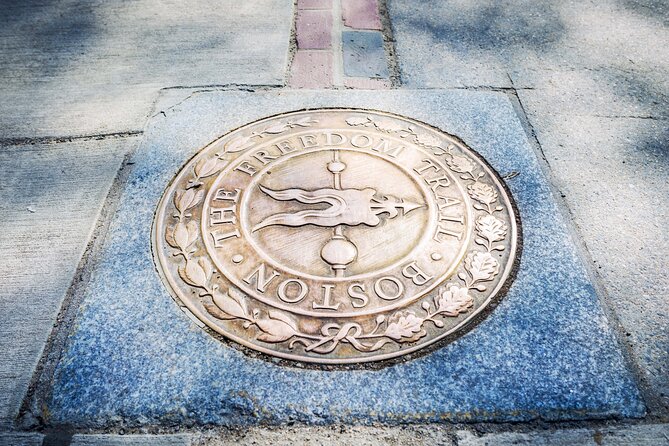
- All 16 official Freedom Trail landmarks: The route links Boston Common, the Granary Burying Ground, Faneuil Hall, Paul Revere’s house, Old North Church, and more.
- A focused Revolutionary period: The guide concentrates on Boston from about 1760 to 1775, when tensions with Britain reached a breaking point.
- A genuinely small group: With no more than 16 people, the guide can handle questions and keep the group together in busy streets.
- A North End finish: The tour ends at Copp’s Hill Terrace, near Hanover Street’s Italian restaurants, pastry shops, and pizza.
- Outdoor history with limited indoor access: Museum admissions are not included, and the tour does not enter the historic buildings along the route.
- A weather-sensitive walk: Bring layers in winter. Guides may use indoor or covered spots for warm-up breaks, but most of the experience is outside.
Why this Freedom Trail walk works well for first-time Boston visitors
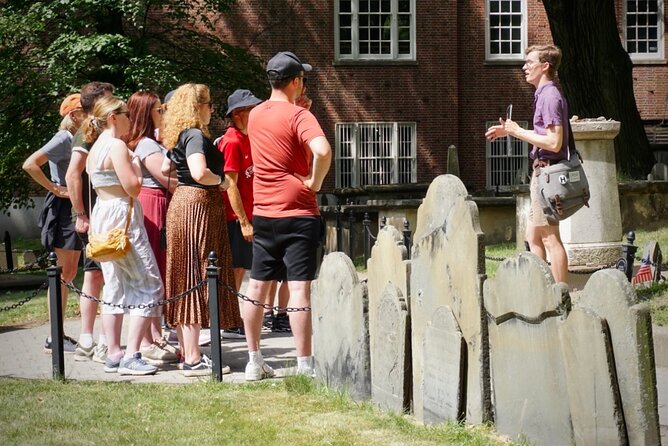
I like starting with the Freedom Trail because it gives you a map of Boston’s historic core before you begin exploring on your own. You are not simply checking off monuments. You are moving through Boston Common, the old civic center, the markets, and the North End while the guide explains how those places fit together.
The tour costs $35.10 per person. That is a fair price if you want a connected story and help finding all 16 official sites. A self-guided walk costs less, of course, but you would need to research the landmarks, manage the route, and decide which details matter. Here, your fee pays mainly for the guide’s preparation, pacing, and answers.
The guides receive especially strong praise for their storytelling and command of Boston’s past. Jon is noted for arranging the story in clear chronological order. Maura is praised for making Revolutionary Boston vivid. Mark, Alejandro, Maz, Nick, Cal, Kiera, Amelia, Miles, and others are also identified with energetic, well-informed tours.
That range matters because the guide shapes the experience. The stops themselves are fixed, but the explanation can change from one guide to another. You should expect a serious history walk with room for questions, not a theatrical show built around costumes or staged scenes.
More History Tours in Boston
- Tour of Historic Fenway Park, America’s Most Beloved Ballpark
★ 4.5 · 3,013 reviews - Boston Food & History: Pizza, North End & Freedom Trail
★ 5.0 · 1,772 reviews - Boston: City Cruises Historical Sightseeing Cruise
★ 4.6 · 1,771 reviews
Boston Common and the city’s Puritan beginnings
Meet inside Boston Common at the Boston Foundation Monument, near the northern edge of the park and opposite 50 Beacon Street. The monument recalls the arrival of the Puritans in 1630, using a bronze relief of two men shaking hands.
This is a useful starting point because it reaches back before the Revolution. Boston’s conflict with Britain did not appear out of nowhere. The guide sets up the city’s religious, political, and social foundations before moving toward the events of the 1760s and 1770s.
You then spend about 20 minutes in Boston Common, described as the oldest public land in the Americas. It began as communal grazing land in 1634. Today it is a city park, but the guide helps you picture its earlier role in daily colonial life.
The Massachusetts State House is also part of the early route. It dates to 1798 and is associated with Boston’s nickname, the Hub of the Solar System. You should not expect a full State House visit on this tour. The value here is the outside view and the explanation of how Boston’s political center developed.
Granary Burying Ground and the people behind the Revolution
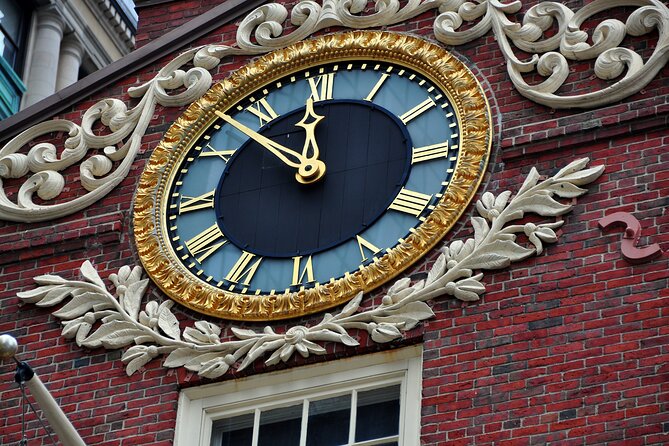
The next section brings you to the Granary Burying Ground, founded in 1660 and Boston’s third-oldest burial ground. About 20 minutes here gives the guide room to discuss the people who shaped Revolutionary Boston, not just the battles and dates.
This is one of the route’s most useful stops for putting names to the period. The burial ground is tied to major colonial and Revolutionary figures, and the stories help turn a broad political struggle into something more personal.
Along the way, you pass King’s Chapel, the first Church of England in Puritan Boston. The original church dates to 1686, with the current building from 1754. You also see Boston’s oldest burying ground, dating to 1630.
These sites show how compact old Boston was. Religious differences, public business, commerce, and burial grounds all occupied the same small area. That closeness helps explain why political disputes could spread quickly through the city.
Boston Latin School and the center of colonial power
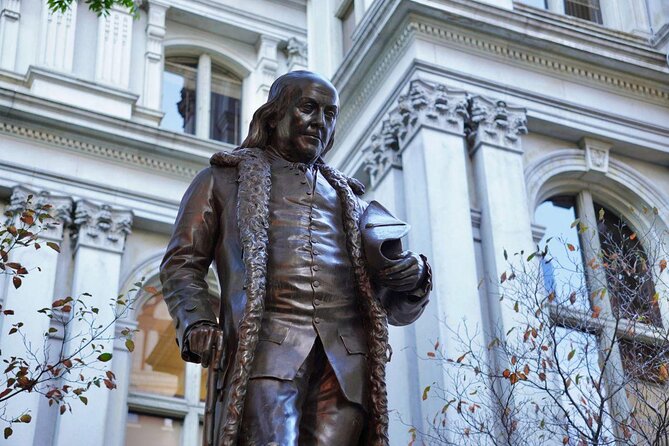
Near the statue of Benjamin Franklin, the guide points out the site of Boston Latin School, founded in 1635 and regarded as the oldest public school in the Americas. The statue gives you a visual marker, but the school site offers the stronger historical point.
Education, public debate, and political influence were closely connected in colonial Boston. Franklin’s place in the story also gives the guide a chance to discuss one of Boston’s best-known political figures without reducing the Revolution to a handful of military heroes.
The route continues past Old City Hall, which served as a center of Boston politics for more than a century, and the former publishing house of Ticknor & Fields. These are easy places to overlook if you walk alone. A guide helps you notice that the Freedom Trail includes civic and literary history, not only Revolutionary battle sites.
You also pass the Old South Meeting House, a Congregationalist meeting house dating to 1729 and the gathering point connected with the Boston Tea Party in 1773. The building is one of the places where public argument became direct political action.
The Old South Meeting House is not included as an interior visit. If you want to go inside, the tour operator notes that Hub Town Tours tickets provide discounted admission there. The same arrangement applies to Old North Church, and a similar discount for King’s Chapel is expected soon. Confirm current arrangements when booking.
More Walking Tours in Boston
- Cambridge: Harvard University Student-Guided Walking Tour
★ 4.6 · 3,931 reviews - Harvard University Campus Guided Walking Tour
★ 4.5 · 3,632 reviews - Boston Freedom Trail Walking Tour with Costumed Guide
★ 4.5 · 2,531 reviews - The Full Revolutionary Story Epic Small Group Boston Walking Tour
★ 5.0 · 2,356 reviews
The Boston Massacre site and the road to open conflict
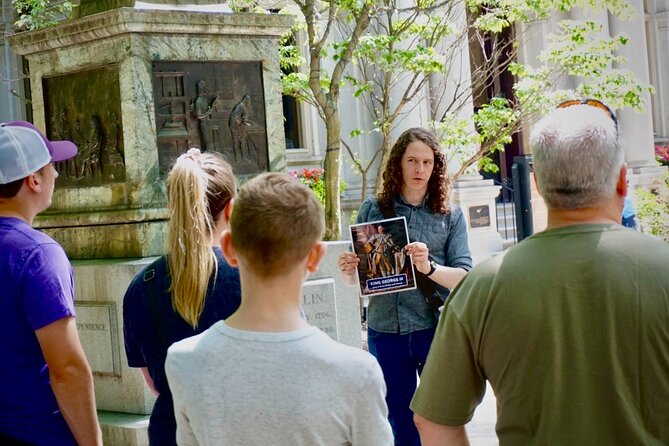
The Old State House is the former colonial capitol of Massachusetts Bay Colony and dates to 1713. It is also the oldest public building in Boston. The building’s location makes it a strong transition point between colonial government and the growing dispute with British authority.
The Boston Massacre site receives about 20 minutes. In 1770, British soldiers killed five Bostonians here. The guide explains the event in its political setting, including the tension created by British troops in the city and the way colonial leaders used the incident to build opposition.
This is one of the places where a historian’s wording matters. A short plaque can tell you what happened. A guide can explain why the event mattered so much, how it was remembered, and how it fed the larger argument between Boston and Britain.
The route also includes a stop connected with a leading member of Boston’s Sons of Liberty. That organization helped organize resistance and shape public opinion. The tour’s focus on 1760 to 1775 gives these stops a clear purpose: you see the pressure building before the first shots of the Revolutionary War.
Faneuil Hall and the public voice of Boston
Faneuil Hall Marketplace receives about 10 minutes. The hall opened in 1742 and hosted Boston’s town meetings. Its familiar title, the Cradle of Liberty, reflects its role as a place where political ideas were argued before large crowds.
This stop helps you understand that the Revolution was fought with speeches, printed arguments, meetings, and public pressure as well as weapons. Boston’s political culture grew in places like Faneuil Hall, where ordinary residents could hear disputes and take sides.
You also pass a historic building from 1704 that now houses the oldest restaurant in the United States, established in 1826. The restaurant itself is not included as a meal or scheduled dining stop. Treat it as a landmark you can return to after the tour if it fits your plans.
The walk through this section can be busy. Staying close to the guide matters, especially around market areas and narrow downtown streets. A group of 16 is much easier to manage than a large crowd, but you should still wear comfortable shoes and listen for route changes.
North Square, Paul Revere, and the North End
North Square Park is the heart of Boston’s North End and dates to 1634. The guide spends about 20 minutes here, bringing the story into one of Boston’s oldest neighborhoods.
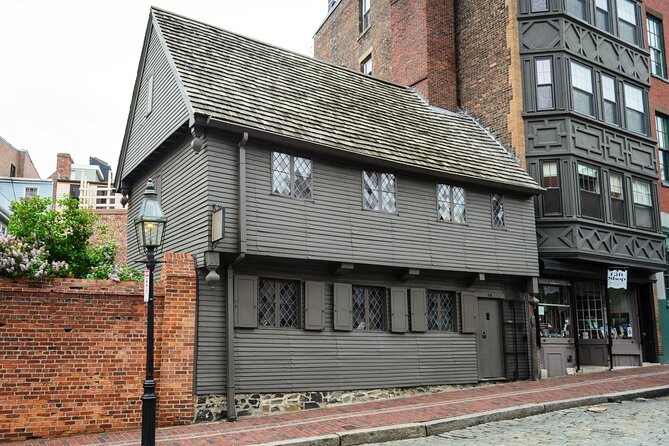
The Paul Revere House is the oldest structure in downtown Boston and was Revere’s home. This is one of the route’s most anticipated stops, but the house interior is not included. You see the building as part of the walk and can plan a separate visit if you want more time inside.
The Paul Revere Statue follows, in a pedestrian-only area honoring his famous midnight ride in 1775. The statue is a natural place to discuss how Revere’s ride has been remembered and how legends can become part of a nation’s identity.
Old North Church is next. The church dates to 1723 and is associated with the signal lanterns used during the midnight ride. Again, you see the church from the route rather than entering it as part of the tour.
You also pass Copp’s Hill Burying Ground, Boston’s second-oldest burying ground. Taken together, the North End stops give you architecture, neighborhood history, religious history, and the story of the Revolution’s opening moments.
Ending at Copp’s Hill Terrace
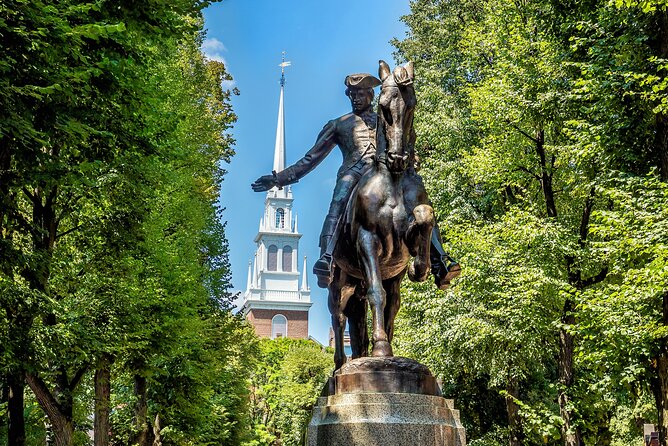
The tour concludes at Copp’s Hill Terrace after about 20 minutes in the final area. The terrace overlooks the Charles River and offers views toward the U.S.S. Constitution and the Bunker Hill Monument.
This ending is useful because it points you toward historic Charlestown without including a Charlestown visit. The U.S.S. Constitution dates to 1797, and Bunker Hill Monument recalls the 1775 battle. You see them across the water, but the tour does not take you into Charlestown.
Afterward, you are close to Hanover Street in the North End. That makes the finish practical for lunch, dinner, pastries, or pizza. The tour does not include food, but the location gives you plenty of choices within a short walk.
Walking conditions, weather, and accessibility
The route lasts about two and a half hours and requires extended standing and walking. The operator recommends a moderate physical fitness level and does not recommend the experience for anyone who has difficulty standing for long periods.
The tour is wheelchair and stroller accessible, and service animals are allowed. You should still consider the demands of an old city route, including outdoor stops and busy streets. The provided information confirms accessibility, but it does not describe every surface or restroom arrangement, so ask the operator if you need specific assistance.
Cold weather is the clearest practical concern. Several winter outings were described as freezing or windy, even when the guide worked hard to keep the group comfortable. Guides may use indoor spaces or covered areas for short warm-up breaks, but you should wear a warm coat, hat, gloves, and suitable shoes.
The walk operates in English and uses a mobile ticket. Confirmation arrives when you book. It is commonly reserved about 22 days ahead, so advance planning makes sense if your Boston dates are fixed.
Who should book this tour?
I would choose this tour for a first Boston visit, a history-focused day, or a family with older children who can manage two and a half hours on foot. The chronological storytelling helps if you know the basic Revolution story but want to connect the people and places.
It also works for repeat visitors who want more context. A Boston resident could still learn something from a guide such as Alejandro, who is noted for making the material useful even to someone familiar with the city.
I would look elsewhere if you want long interior visits, a relaxed pace, or a tour built around food and shopping. Museum admissions are not included, and the experience stays focused on outdoor landmarks and historical explanation.
The cancellation terms are practical but firm. You receive a full refund if you cancel at least 24 hours before the start time. Cancellations or changes inside 24 hours are not refunded. Poor weather or failure to reach the minimum group size can lead to a new date or a full refund.
Should you book the Freedom Trail History Small Group Walking Tour?
Book it if you want the Freedom Trail explained as one connected story rather than a string of plaques. The strongest reasons are the small group, the clear focus on 1760 to 1775, and the guides’ ability to answer questions and bring political history down to street level.
Bring layers, expect to remain outside, and plan separate visits to the Old South Meeting House, Old North Church, King’s Chapel, or Paul Revere House if you want to see their interiors. At $35.10, this is good value for a well-paced introduction to Boston’s historic center.
FAQ
Where does the Freedom Trail tour begin?
The tour begins at the Boston Foundation Monument inside Boston Common, near the park’s northern boundary and opposite 50 Beacon Street, Boston, Massachusetts 02108.
Where does the tour end?
The tour ends at Copp’s Hill Terrace, 520 Commercial Street, Boston, Massachusetts 02109. The terrace overlooks the Charles River and is close to restaurants and pastry shops on Hanover Street.
How long is the walking tour?
The tour lasts approximately two hours and 30 minutes.
How many people can join the group?
The maximum group size is 16 travelers.
Does the tour visit all 16 Freedom Trail landmarks?
Yes. The experience covers all 16 official historic landmarks on the Freedom Trail.
Are museum or historic building admissions included?
No. Admission inside museums and historic buildings is not included. The tour focuses on outdoor visits and explanations along the route.
Is the tour wheelchair and stroller accessible?
Yes. The experience is described as wheelchair and stroller accessible. A moderate level of physical fitness is still recommended because the tour involves extended standing and walking.
Is the tour offered in English?
Yes. The tour is offered in English.
What happens if the weather is poor?
The experience requires good weather. If the operator cancels because of poor weather, you are offered a different date or a full refund.
More Freedom Trail Tours in Boston
- Boston’s Freedom Trail: A Revolutionary Walking Tour
★ 4.9 · 1,748 reviews - Boston: Freedom Trail History Small Group Walking Tour
★ 4.9 · 1,590 reviews - Boston’s Freedom Trail: A Revolutionary Walking Tour
★ 5.0 · 1,343 reviews - Freedom Trail Walking Tour 250
★ 4.5 · 1,118 reviews
Just added around Boston
- Boston’s Freedom Trail: A Revolutionary Walking Tour★ 5.0 · 1,343 reviews
- Delicious Donuts of Boston: A Sweet History Walking Tour★ 5.0 · 1,038 reviews
- Freedom Trail Walking Tour 250★ 4.5 · 1,118 reviews
- Narrated Sunset Cruise of Boston Harbor★ 4.0 · 532 reviews
- Sunset Sailing Cruise on a Tall Ship in Boston Harbor★ 4.5 · 414 reviews
- Boston’s North End Food and History Walking Tour★ 5.0 · 459 reviews
- Boston North End Food Tour of 6+ Tastings, Cannoli, Lobster Roll★ 5.0 · 1,404 reviews
- Boston’s North End Food Tour: Italian Flavors & Heritage Walk★ 5.0 · 1,322 reviews
Boston Tours, compared.
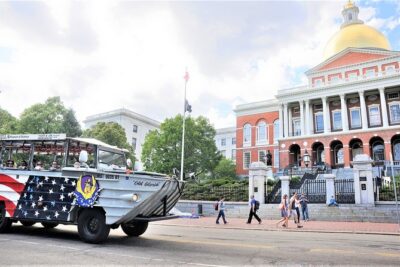
Boston Duck Boat Sightseeing City Tour with Cruise Along Charles River
Read our review →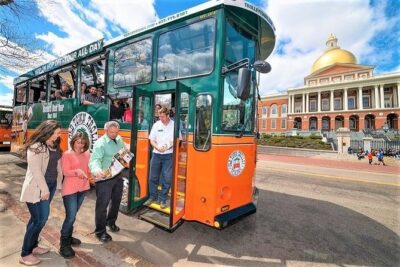
Boston Hop-On Hop-Off Trolley Tour with 13 Stops
Read our review →
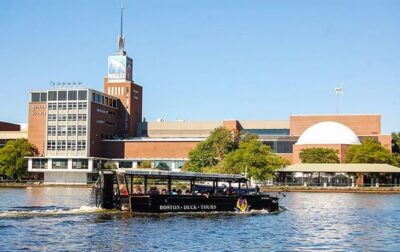
Boston Duck Tour: The Original and World-Famous
Read our review →
Cambridge: Harvard University Student-Guided Walking Tour
Read our review →
Harvard University Campus Guided Walking Tour
Read our review →
Boston Fenway Park: Guided Ballpark Tour with Options
Read our review →
City Cruises Boston Whale Watching Cruise by High-Speed Boat
Read our review →Browse the lists this tour appears in