
Reviewed · BOSTON
Entire Freedom Trail Walking Tour: Includes Bunker Hill and USS Constitution
Boston’s Freedom Trail is more than a line painted on the sidewalk. It is a 2.8-mile story about protest, power, money, violence, and the ordinary people caught between Britain and a new American government. This tour covers the entire route, from the Massachusetts State House to the USS Constitution, with Bunker Hill added to complete the picture. I especially like the way guide Mark connects one event to the next, and I like that the walk includes less obvious places such as the Ebenezer Hancock House and Blackstone Block. The main drawback is simple: four hours on foot is a serious commitment.
I also like the small group, capped at 16 people, and the practical pace. Mark uses maps, answers questions, and adds context about women and lesser-known figures rather than stopping only for the famous names. Still, this is not a quick orientation walk. You should expect close to 10,000 steps, uneven city sidewalks, and a lot of information.
Key points at a glance
- The complete route: Walk from Park Street through downtown Boston, the North End, Charlestown, Bunker Hill, and the USS Constitution.
- A connected story: Mark explains how tax disputes, court cases, violence, propaganda, and military action built toward war.
- Small-group format: The tour allows no more than 16 people, which makes questions and city crossing easier.
- Historic ships and battlefields: The final stops cover the Battle of Bunker Hill and Old Ironsides, the world’s oldest commissioned warship.
- Mostly an outdoor experience: Admission to building interiors is not included, so the value comes mainly from the guide’s narration and the sites themselves.
- Plan for the walk: Wear comfortable shoes, bring water, and allow four hours without trying to squeeze in another appointment.
Why the full Freedom Trail works better as one story

Boston’s historic sites make more sense when you see them in sequence. The Massachusetts State House introduces the government that still serves the state. A few blocks later, Granary Burying Ground puts names and faces on the political argument. By the time you reach the Old State House and the Boston Massacre site, the quarrel has turned into bloodshed.
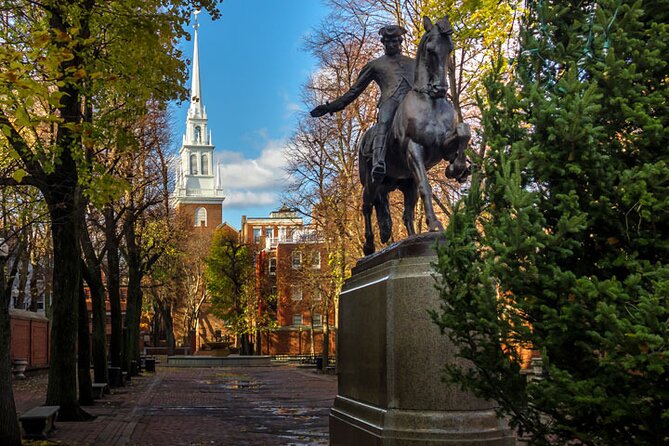
That order matters. You are not simply checking off Paul Revere’s house, Faneuil Hall, and the Old North Church. You are following a chain of cause and effect. Mark’s strength is making that chain clear, with maps and stories that connect major figures to people who receive less attention in standard school lessons.
The tone is conversational and lightly funny, but the approach is not theatrical. If you want costumed actors or a dramatic performance, this is not that kind of tour. If you want a serious walk led by someone who has spent years studying the Revolution, it is a better fit.
More Walking Tours in Boston
- Boston: Freedom Trail History Small Group Walking Tour
★ 5.0 · 6,450 reviews - Cambridge: Harvard University Student-Guided Walking Tour
★ 4.6 · 3,931 reviews - Harvard University Campus Guided Walking Tour
★ 4.5 · 3,632 reviews
Starting at the State House and Park Street
The meeting point is at Beacon Street and Park Street, near the Massachusetts State House. The tour begins at 10:00 a.m., a useful start time for seeing the central sites before the day gets too far along.
The current State House is the third building connected with Massachusetts government. Charles Bulfinch designed it, and the stop gives you a quick look at how the colony’s political institutions developed into the state government you see today. The tour does not include admission inside, so you should treat this as an exterior introduction rather than a building visit.
Park Street Church comes next. When built, it was the tallest building in the country, and its later connection to the abolition movement adds a reminder that Boston’s moral and political arguments did not end with independence. The nickname Brimstone Corner refers both to fiery sermons and to a surprising former use of the church cellar, a small detail that helps keep the stop from feeling like a dry architecture lesson.
The first stretch is manageable, but remember that the clock includes many stops. You will often stand while listening, then walk a few blocks to the next place.
Granary Burying Ground and King’s Chapel
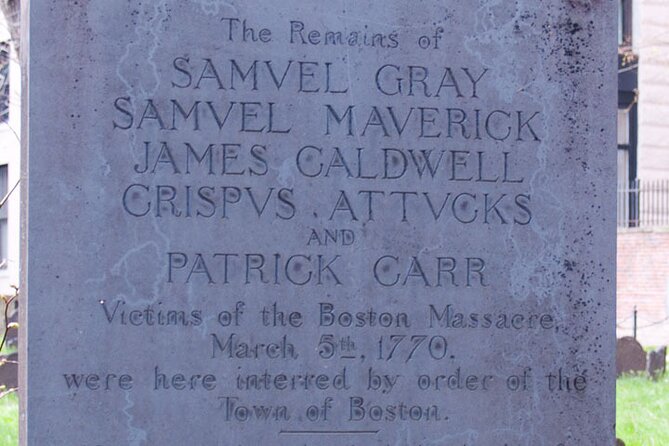
Granary Burying Ground is one of the strongest early stops. Samuel Adams, Paul Revere, John Hancock, and victims of the Boston Massacre are buried here. Mark introduces the people behind those names and explains their roles instead of treating the cemetery as a quick photo stop.
This is where the Revolution begins to feel personal. Political arguments can seem abstract when you read about them in a book. Seeing the graves of the people who pushed, suffered, or died during the conflict gives the story weight.
King’s Chapel brings an earlier dispute into view. The 1749 Anglican church was tied to the struggle between Puritans and the English crown, including the seizure of land for an unwanted church in Boston during the 1680s. That background is useful because it shows that tension between local religious communities and royal authority existed long before the Boston Tea Party.
Interior admission is not included at King’s Chapel. If seeing the inside matters to you, check the church’s separate admission arrangements and schedule another visit. On this tour, the focus remains on the building’s place in the political story.
Old City Hall and the meeting house that launched a crisis
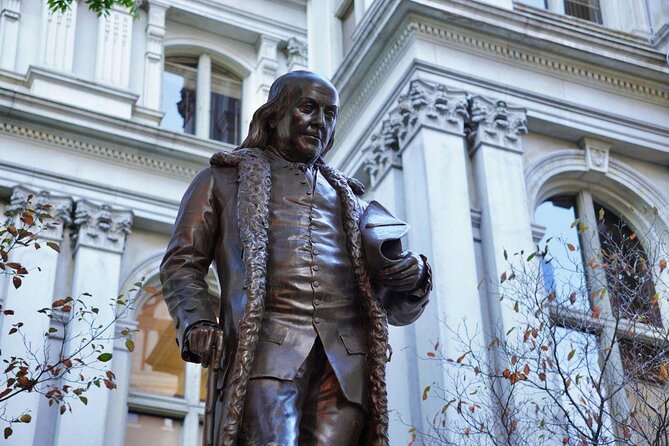
At Old City Hall, you will see a statue of Benjamin Franklin and a marker for the oldest still-operating school in the colony. The stop is brief, but it widens the story beyond soldiers and famous politicians. Education, printing, public debate, and civic identity all helped shape Boston’s political culture.
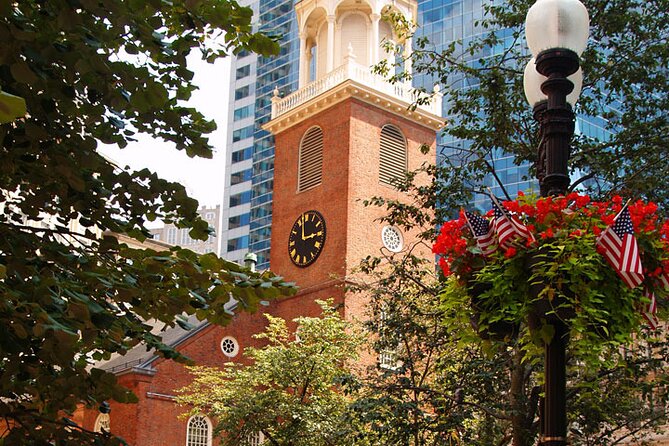
The Old South Meeting House is one of the most important stops downtown. Large meeting halls gave preachers and politicians a place to address crowds, and this was where Samuel Adams helped set the Boston Tea Party in motion.
The point is not simply that tea was thrown into the harbor. The meeting house helps explain how public meetings could turn frustration into organized action. It also shows why the British government saw Boston not as a place with a few noisy protesters, but as a center of resistance.
Admission to interiors is not part of the $79 tour price. That is a fair trade for some visitors because you get the full route and a guide for four hours. It is less appealing if you hoped to explore every church and museum along the way. Think of this as a guided outdoor history experience, not a pass to Boston’s historic buildings.
More Freedom Trail Tours in Boston:
- Boston Freedom Trail Walking Tour with Costumed Guide
★ 4.5 · 2,531 reviews - Boston Food & History: Pizza, North End & Freedom Trail
★ 5.0 · 1,772 reviews - Boston’s Freedom Trail: A Revolutionary Walking Tour
★ 4.9 · 1,748 reviews - Boston: Freedom Trail History Small Group Walking Tour
★ 4.9 · 1,590 reviews
The Old State House and Boston Massacre

The Old State House once served as the seat of the British government in Boston. Here you hear about the 1761 court battle that challenged colonial rights and helped expose the growing conflict between local interests and royal authority.
The same area is tied to the 1770 Boston Massacre. The familiar version says innocent citizens were gunned down in cold blood. A good guide should make you pause over that wording, and Mark uses the site to question the simple version and explain how the event was presented to the public.
That distinction matters. The Revolution was fought with muskets, but also with stories, images, speeches, and carefully shaped public opinion. At this stop, you get a clearer view of how an incident could become political fuel.
The Old State House is in a busy downtown area, so staying close to the guide matters. The small group helps, especially when the route crosses crowded streets and sidewalks. Mark’s role is not only to explain the past but also to move the group through modern Boston without losing people.
Faneuil Hall, Blackstone Block, and Ebenezer Hancock
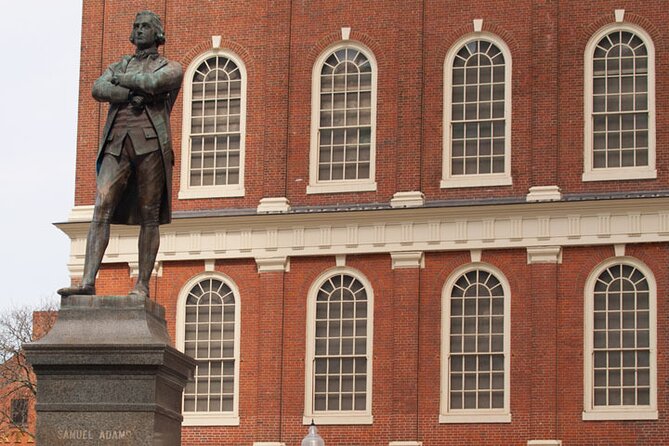
Faneuil Hall is often called the Cradle of Liberty, and its history comes from the people who used it. Samuel Adams spoke there about taxation and representation. Frederick Douglass later spoke there as an escaped slave and abolitionist.
This is a useful point in the walk because it connects the Revolution to later American arguments about freedom. The building did not belong to one generation or one cause. Public halls could serve merchants, politicians, reformers, and critics of the government.
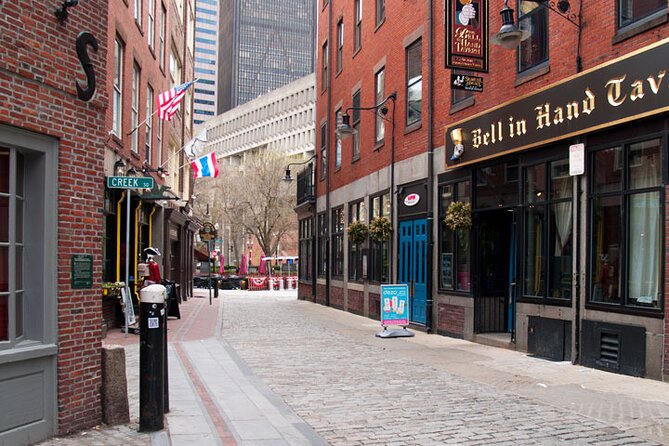
The Blackstone Block offers a more intimate look at the city. You will hear about the Massachusetts Spy newspaper, a bar described as the Headquarters of the Revolution, and the home of Ebenezer Hancock, John Hancock’s brother. French money sent to support the Revolution was stored in that house.
I like this part because it moves away from the most photographed landmarks. Small sites often explain how a rebellion functioned day to day. Newspapers spread arguments, taverns gathered people, and private homes could become places for handling money and planning action.
Paul Revere House and the North End
The Paul Revere House is one of Boston’s oldest surviving homes. Revere bought the 1680 house in 1770 and later raised a large family there, fathering 16 children with two wives.
The detail helps correct the polished image of Revere as only a midnight rider. He was a craftsman, businessman, family man, messenger, and political participant. The house gives you a more ordinary setting for a person who became a national symbol.
The tour does not include interior admission. You will see the house as part of the route and hear how Revere fit into the events around him, but you should not expect a museum visit inside.
At Old North Church, the story turns from politics to military warning. Lanterns displayed there alerted Patriots across the water in Charlestown that British regulars would travel through Cambridge on their way toward Lexington and Concord. The church is one of the clearest spots for understanding how geography shaped the opening movements of the war.
Copp’s Hill Burying Ground follows. From here, Mark explains the geography of the Battle of Bunker Hill and points out a grave marker with its own story. This stop prepares you for the walk across to Charlestown, where the tour leaves the compact downtown section behind.
Bunker Hill Monument and the battle that was not quite at Bunker Hill
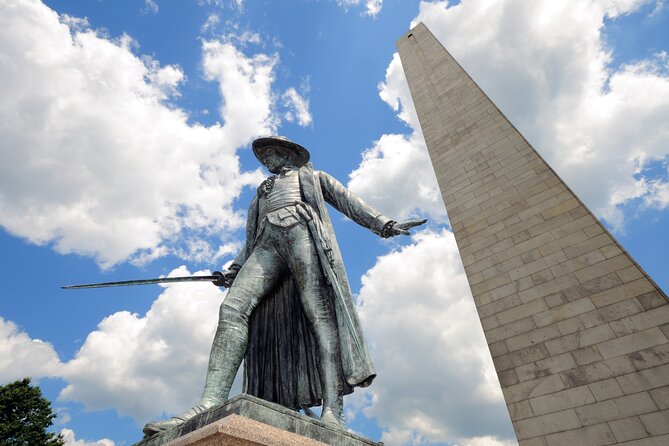
The Bunker Hill Monument is the historical payoff for the Charlestown section. The battle was actually fought on Breed’s Hill, a point many visitors learn only after arriving. The Patriots lost the ground, but British casualties were roughly three times those suffered by the colonial forces.
That fact changes the meaning of the battle. It was a military defeat for the Patriots, but a warning to the British that putting down the rebellion would be costly. Mark uses the location to explain the battlefield rather than treating the monument as a quick final photo.
This is also where the length of the tour becomes clear. Four hours gives the guide time to build toward the battle, but it means you should keep your energy in reserve. The walking is mostly on city streets and described as a manageable pace, yet you are still covering nearly three miles with frequent standing stops.
Finishing at USS Constitution
The tour ends at the Charlestown Navy Yard, at USS Constitution, known as Old Ironsides. It is the oldest commissioned warship in the world and served the United States in both domestic and foreign waters.
Ending here works well. The Freedom Trail begins with political resistance and ends with the young nation’s military power. The ship also gives the story a physical object that you can remember after the names and dates begin to blur.
Admission to the USS Constitution itself is not included, and the experience concludes at the ship and its museum area. You can plan a separate visit if you want more time inside. Since the tour ends in Charlestown rather than returning to Park Street, consider that when arranging lunch, transportation, or your next activity.
What $79 buys you
At $79 per person, this is not the cheapest way to walk the Freedom Trail. You can follow the painted line on your own for little or no cost. The question is what you want from the route.
I think the price is reasonable if you want the full story in one sitting, especially with Bunker Hill and USS Constitution included. You are paying for four hours of narration, route management, historical context, and the chance to ask questions in a group of no more than 16. Guide gratuity is included, so you do not need to budget an additional tip.
The value drops if you prefer to spend a long time inside each museum or church. Interior admission is not included, and the schedule allows only short visits at many stops. Independent visitors who enjoy reading plaques and setting their own pace may prefer to split the trail across two days.
Who should book this Boston walk?
I would choose this tour for history fans, first-time Boston visitors, families with teenagers, and anyone who wants the Revolution explained as one connected story. It also suits couples and older walkers who can manage a moderate four-hour walk. Several stops are short, and the pace is described as slow enough for seniors, but comfortable shoes remain essential.
Children under 12 may find the detail heavy unless they already enjoy history. Teenagers are more likely to appreciate the mix of battles, politics, famous characters, and real city streets.
The tour is offered in English. Service animals are allowed, public transportation is nearby, and the group size is limited. Because the activity depends on good weather, poor conditions can lead to a different date or a full refund. You can cancel for a full refund up to 24 hours before the start time, but late cancellations and changes are not accepted.
My verdict on the Entire Freedom Trail Tour
Book it if you want to understand Boston rather than simply photograph it. Mark’s approach is especially useful for making cause and effect plain, bringing in women and less famous figures, and pointing out places that many basic walks skip.
Skip it if four hours of walking sounds tiring, if you want extensive interior visits, or if you prefer complete control over your own pace. For everyone else, the tour offers a strong way to cover the entire Freedom Trail, Bunker Hill, and USS Constitution without having to stitch the story together yourself.
FAQ
How long is the Entire Freedom Trail Walking Tour?
The tour lasts approximately four hours and covers about 2.8 miles, or 4 kilometers, from central Boston to Charlestown.
Where does the tour begin?
It begins at Beacon Street and Park Street in Boston, near the Massachusetts State House.
What time does the tour start?
The scheduled start time is 10:00 a.m.
Where does the tour end?
The tour ends at USS Constitution in the Charlestown Navy Yard, at the USS Constitution Museum area.
Does the tour include Bunker Hill?
Yes. The route includes Bunker Hill Monument and an explanation of the Battle of Bunker Hill, which was fought on Breed’s Hill.
Is admission to the historic buildings included?
No. Admission to interiors is not included. The tour does include the outdoor walking route and narration.
Is USS Constitution included?
USS Constitution is the final stop, but interior admission is not included.
How many people can join the tour?
The group is limited to a maximum of 16 people.
Can I cancel the tour for a refund?
Yes. You can cancel at least 24 hours before the start time for a full refund. If poor weather causes the operator to cancel, you will be offered another date or a full refund.
Just added around Boston
- Boston’s Freedom Trail: A Revolutionary Walking Tour★ 5.0 · 1,343 reviews
- Delicious Donuts of Boston: A Sweet History Walking Tour★ 5.0 · 1,038 reviews
- Freedom Trail Walking Tour 250★ 4.5 · 1,118 reviews
- Narrated Sunset Cruise of Boston Harbor★ 4.0 · 532 reviews
- Sunset Sailing Cruise on a Tall Ship in Boston Harbor★ 4.5 · 414 reviews
- Boston’s North End Food and History Walking Tour★ 5.0 · 459 reviews
- Boston North End Food Tour of 6+ Tastings, Cannoli, Lobster Roll★ 5.0 · 1,404 reviews
- Boston’s North End Food Tour: Italian Flavors & Heritage Walk★ 5.0 · 1,322 reviews
Boston Tours, compared.

Boston Duck Boat Sightseeing City Tour with Cruise Along Charles River
Read our review →
Freedom Trail History Small Group Walking Tour
Read our review →
Boston Hop-On Hop-Off Trolley Tour with 13 Stops
Read our review →

Boston Duck Tour: The Original and World-Famous
Read our review →
Cambridge: Harvard University Student-Guided Walking Tour
Read our review →
Harvard University Campus Guided Walking Tour
Read our review →
Boston Fenway Park: Guided Ballpark Tour with Options
Read our review →Browse the lists this tour appears in