

Reviewed · SAN DIEGO
USS Midway Museum Admission: Valid Any Date
The USS Midway is not a ship-shaped museum. It is a real 4-acre aircraft carrier that once carried 4,500 people, housed its own kitchens and sleeping quarters, and served from 1945 to 1992. Walking its decks gives naval history a human scale. You see where sailors slept, worked, ate, and launched aircraft.
I especially like the audio tour told by former Midway sailors and officers, and the retired crew members in yellow shirts who bring the flight deck to life with personal stories. The 25 restored aircraft, working ship spaces, flight simulators, and downtown San Diego views give you plenty to do beyond reading display panels.
The main drawback is simple: the ship is huge, and much of it involves stairs, narrow passageways, and steady walking. Two hours covers the highlights, but three to five hours makes more sense if you want the audio tour, aircraft, living quarters, and conversations with the volunteers.
Key points to know before you board
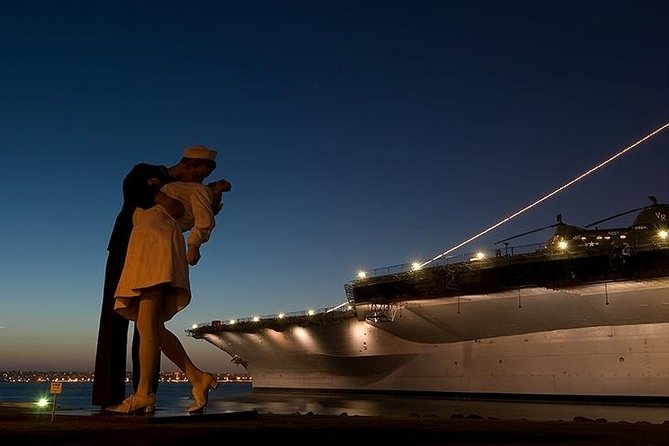
- The carrier served from 1945 to 1992: USS Midway was the US Navy’s longest-serving aircraft carrier of the 20th century.
- You can explore at your own pace: Admission is valid on any date, during regular museum hours, with no fixed tour departure.
- The audio tour adds real voices: Former officers and sailors explain the ship and daily life at sea.
- The yellow-shirt volunteers are a major highlight: Many served aboard Midway and can explain details that signs cannot.
- Plan for at least three hours: The ship covers four acres and includes 65 highlighted locations, aircraft, exhibits, and working spaces.
- The flight deck is the great payoff: You get restored aircraft, a 360-degree view of San Diego, and a clear sense of the carrier’s scale.
A four-acre aircraft carrier in downtown San Diego
The USS Midway sits on the Embarcadero, close to downtown San Diego and near public transportation. You board from Navy Pier and enter a ship that was once, for about a decade, the largest in the world.
That size matters. Midway was too large to pass through the Panama Canal, and more than 225,000 sailors served aboard during its working life. Once inside, you are not simply looking at military objects behind glass. You are moving through a compact city at sea.
The carrier had galleys, sleeping quarters, officer’s country, an engine room, command spaces, aircraft handling areas, and a flight deck. Each section helps answer a different question: How did thousands of people eat? Where did they sleep? How did aircraft move around a moving ship? How did the crew keep such a large machine operating?
The museum does not force you into a scheduled group. You can arrive any time during opening hours and set your own pace. That flexibility is useful if you are combining Midway with other stops along the waterfront.
More Museums in San Diego:
- San Diego: USS Midway Museum Entry Ticket
★ 4.9 · 3,896 reviews - NYC: 9/11 Memorial & Museum Timed-Entry Ticket
★ 4.8 · 31,428 reviews - NYC: Empire State Building Tickets – Observatory & Museum
★ 4.7 · 25,757 reviews
Start with the flight deck or work upward

The ship offers a lot of choice, but you will get more from it if you approach it with a plan. Some people prefer to begin on the flight deck, then work down through the ship. That is a good strategy because the outdoor deck gives you an immediate sense of scale before the enclosed spaces begin to blur together.
Others may want to start with the audio tour in the hangar deck. Either approach works, but do not treat the ship like a quick photo stop. The 65 highlighted locations spread across several decks, and the most interesting parts are not always the biggest.
A practical route is to see the flight deck and aircraft first, then visit the hangar deck, living areas, bridge, and engine room. Keep time for the volunteers. A short conversation with a former crew member may explain a piece of equipment or a flight operation better than a long panel.
The elevator provides access from Navy Pier onto the ship, from the hangar deck down to the second deck, and up to the flight deck. Still, the full experience requires a moderate level of physical fitness, and some routes include stairs and extended walking.
The flight deck and 25 restored aircraft
The flight deck is the visual center of the museum. It covers roughly four acres, giving you room to walk among 25 restored aircraft and look across San Diego Harbor toward the downtown skyline.
The aircraft are not just decoration. They help you understand the carrier as an operating airfield. On land, an aircraft feels large. On Midway’s deck, you see how much coordination was needed to move, maintain, fuel, and launch planes in a tight space surrounded by ocean.
Some aircraft can be viewed closely, and the museum includes climb-aboard aircraft and interactive features for different ages. If you have children with you, this section gives them something physical to examine while the adults take in the history.
The deck can also be the best place to pause. You get a 360-degree view of downtown San Diego, and the open air provides a welcome change after narrow interior passageways. Bring a hat or water, particularly during a warm day, since you may spend more time outside than expected.
The yellow-shirt volunteers are especially valuable here. They can explain how the flight deck worked and share memories of life aboard Midway. Their presence turns the aircraft display from a static collection into a conversation about real work, danger, routine, and teamwork.
Hear the ship through former crew members

The included audio tour is one of the strongest reasons to choose admission rather than simply viewing the ship from the waterfront. It is narrated through stories from former Midway officers and sailors, giving you a direct link to the people who served aboard.
Use it selectively if you are short on time. If you have three hours or more, listen to as much as you can while moving between the highlighted locations. The narration helps connect the ship’s equipment to the people who used it.
A narrated video tour covering the museum exhibits also runs continuously on the hangar deck. This is useful if you want a broad introduction before choosing which areas deserve more time.
The audio material works best when paired with the physical spaces. Hearing about shipboard routines while standing near the sleeping quarters or galley gives the information weight. You begin to picture the carrier as a workplace that ran day and night, not as a silent monument.
A few more San Diego days worth weighing up
- San Diego Zoo 1-Day Pass: Any Day Ticket
★ 4.5 · 4,248 reviews - San Diego Harbor Cruise
★ 4.5 · 2,980 reviews - San Diego Hop On Hop Off Trolley Tour
★ 4.5 · 2,523 reviews - San Diego Whale Watching Cruise
★ 5.0 · 2,317 reviews
Living quarters, galleys, and the engine room
The restored living spaces show the less glamorous side of naval service. The carrier carried thousands of people, and the sleeping quarters, galleys, and officer’s country reveal how daily life was organized in a crowded environment.
These sections are often more memorable than the aircraft because they show the ordinary work behind the dramatic moments. Sailors needed meals, rest, medical care, repairs, and clear orders. The ship had to function as a community as well as a fighting vessel.
The engine room and mechanical areas give you another view of the carrier. The scale of the machinery helps explain why Midway required so many crew members. It also makes the ship’s age and working life more tangible.
Do not rush through these interior sections. The passageways can feel repetitive if you move too quickly, but stopping to read the signs and talk with volunteers makes them useful. You may find that a modest room or work area explains the carrier better than the most polished exhibit.
The bridge and the business of running a ship
The bridge is one of the 65 highlighted locations and offers a clearer sense of how Midway was directed. From here, the ship’s officers managed navigation, communication, and operations across a vessel that functioned like a small city.
You will also see why naval work demanded strict organization. Aircraft, engines, food, maintenance, navigation, and personnel all had to operate together. A delay in one area could affect the entire ship.
The museum’s interactive exhibits help make these systems easier to understand. They are particularly useful for children and for anyone who does not already know naval terminology. You can approach the experience as military history, aviation history, engineering, or social history. Midway supports all four.
Flight simulators and hands-on exhibits

The flight simulators add a more active element to a visit that otherwise involves walking, listening, and reading. They are a good option if younger members of your group need a break from historical displays.
The interactive exhibits also help explain how aircraft and ship operations worked. You should not expect every feature to appeal equally to every age group, but the mix keeps the museum from becoming a long series of display panels.
The hands-on areas are also useful when you are visiting with someone who is less interested in military history. One person can spend time with aircraft and simulators while another listens to the audio tour or speaks with a volunteer.
How long should you allow?

The advertised visit can take roughly two to five hours. I would treat two hours as the shortest worthwhile visit, not the ideal length.
With two hours, focus on the flight deck, the aircraft, a few interior areas, and the main audio stops. You can see the ship, but you will need to make choices.
Three to four hours gives you a much better visit. You can listen to more of the narration, stop at the living quarters, visit the bridge and engine room, and speak with yellow-shirt volunteers without watching the clock.
Five hours makes sense if you enjoy history, aviation, engineering, or military museums. It also works well if you want a relaxed lunch break at the onboard café and then more time aboard.
Wear comfortable walking shoes. You will cover a lot of ground, and several sections involve stairs. Bring water and consider a snack, although the ship has a café. Early arrival is wise in summer because nearby parking can be limited.
Is the $41 admission good value?
At $41 per person, this is not a cheap casual attraction. It is good value if you use the included audio tour and spend several hours aboard.
The price covers admission, the audio tour, taxes, fees, and access to the museum’s exhibits, aircraft, living spaces, flight deck, and interactive features. It also includes access to Embarcadero Adventure offers with discounts for nearby attractions.
The value improves when you compare the experience with a standard museum visit. You are not only viewing objects. You are walking through a preserved carrier, climbing between decks, standing in former work spaces, and hearing from people connected to the ship.
It is less useful if you only have time for a quick walk on the flight deck. If your schedule allows just an hour, you will see the ship but miss much of what makes the admission worthwhile.
Parking is separate and available nearby through Ace Parking. Since summer parking can be limited, public transportation or an early arrival may save time and frustration.
Who will enjoy USS Midway most?
I would recommend Midway to anyone interested in aviation, naval service, engineering, or 20th-century American history. It is also a strong family attraction because the aircraft, simulators, and climb-aboard elements give younger visitors something to do.
You do not need a military background to appreciate it. The strongest parts explain daily life in plain physical terms: where people slept, how they ate, how aircraft moved, and how a crew kept an enormous ship working.
It suits independent visitors particularly well because you can choose your own route and pace. Couples, solo visitors, families, and groups can all use the ship differently.
The main caution is mobility. The museum provides elevator access on several key routes and is described as accessible for people with disabilities, but the full experience still includes substantial walking and some stairs. If you have limited mobility, ask staff for the most practical route when you arrive.
Tickets, hours, and cancellation
The museum is open daily from 10 a.m. to 5 p.m., with last admission at 4 p.m. Give yourself a firm arrival time before 4 p.m., since entering near closing leaves too little time for a meaningful visit.
The mobile ticket lets you proceed to the front gate rather than first joining the ticketing line. It does not remove lines inside the attraction, so flexibility at the entrance does not mean every exhibit will be immediate.
Free cancellation is available up to 24 hours before the experience start time for a full refund. Cancellations or changes made within 24 hours are not refunded or accepted.
Should you book the USS Midway?
Yes, if you can spare at least three hours and want more than a quick waterfront attraction. The ship’s size, restored aircraft, former crew voices, and yellow-shirt volunteers make it one of San Diego’s most substantial historical stops.
Book it with realistic expectations. You will walk, climb, listen, and read. You will not see every section in a rushed visit, and the $41 price feels high if you stay only briefly.
Arrive early, wear good shoes, start with the flight deck or audio tour, and leave room for unplanned conversations with the former sailors. If you follow that plan, USS Midway offers a clear, memorable look at how thousands of people lived and worked aboard a floating city.
FAQ
How much does USS Midway Museum admission cost?
Admission costs $41 per person.
Is the ticket valid on any date?
Yes. The admission is listed as valid on any date during the museum’s regular operating hours.
What are the USS Midway Museum opening hours?
The museum is open Monday through Sunday from 10 a.m. to 5 p.m. Last admission is at 4 p.m.
How long should I plan for the museum?
Plan for two to five hours. Two hours covers the main highlights, while three to five hours gives you time for the audio tour, aircraft, interior spaces, exhibits, and volunteers.
Is an audio tour included?
Yes. The admission includes an audio tour narrated through stories from former Midway officers and sailors.
Can I explore the ship independently?
Yes. This is a self-guided visit, so you can arrive during opening hours and explore at your own pace.
What can I see aboard the USS Midway?
You can visit the flight deck, bridge, engine room, galleys, sleeping quarters, officer’s country, interactive exhibits, flight simulators, and 25 restored aircraft.
Is parking included?
No. Parking is not included. Parking is available next to Midway through Ace Parking for an additional fee, and summer parking can be limited.
Is the museum accessible by elevator?
Elevator access is available from Navy Pier onto the ship, from the hangar deck down to the second deck, and up to the flight deck.
Can I cancel for a refund?
Yes. You can cancel at least 24 hours before the experience start time for a full refund. Cancellations within 24 hours are not refunded.
Just added around San Diego
- Original La Jolla Sea Cave Kayak Tour for Two★ 4.5 · 871 reviews
- Behind-the-Scenes at Petco Park Tour★ 4.5 · 339 reviews
- Kayak Tour of the 7 Caves★ 4.5 · 355 reviews
- La Jolla Sea Caves Kayak Tour For Two (Tandem Kayak)★ 4.5 · 1,205 reviews
- Incredible Slot Canyons to the Pacific★ 5.0 · 373 reviews
- Cali Dreaming Electric Bike Tour of La Jolla and Pacific Beach★ 5.0 · 387 reviews
- SoCal Riviera Electric Bike Tour of La Jolla and Mount Soledad★ 5.0 · 438 reviews
- Whale Watching Excursion in Dana Point★ 4.5 · 676 reviews
San Diego Tours, compared.






LEGOLAND® California Theme Park Admission Tickets
Read our review →
Browse the lists this tour appears in