
Reviewed · NEW YORK CITY
New York City: Catacombs by Candlelight
The most unusual part of this New York tour is not the candlelight. It is the chance to enter two walled cemeteries and the active Catholic catacombs beneath St. Patrick’s Old Cathedral, places most people pass without knowing they are there. Bishops rest beside bankers, merchants, lawyers, political figures, and members of the Delmonico family.
I like the way the tour connects church history with the wider story of New York, especially the neighborhood’s Irish and Italian past. I also like the guides’ strong personal style. Tony, Leo, Ronnie, Jimmy Boyle, Dan, and others are praised for telling clear stories, handling questions, and adding humor without turning the church into a stage show.
The main drawback is scale. The catacombs are a series of old vaults, not a huge underground city, and some visitors may wish for more time below ground. You will also need to manage one flight of stairs, and the tour is not fully wheelchair accessible despite general accessibility information.
Key points to know before you book
- Two closed cemeteries: Walk through walled burial grounds that are not open to the general public.
- A working Catholic church: St. Patrick’s Old Cathedral remains an active parish, so quiet and respectful behavior matter.
- Guides make the difference: Tony, Leo, Ronnie, Jimmy Boyle, Dan, and others are praised for local stories, humor, and patient answers.
- A compact 90-minute experience: The tour covers the church, cemeteries, and catacombs without taking up most of your day.
- A small but unusual underground visit: Expect historic vaults and burial places, not a vast maze of tunnels.
- Plan for stairs and proper clothing: Comfortable shoes, weather-appropriate clothing, and no shorts or sleeveless shirts are required.
Why St. Patrick’s Old Cathedral is worth your time
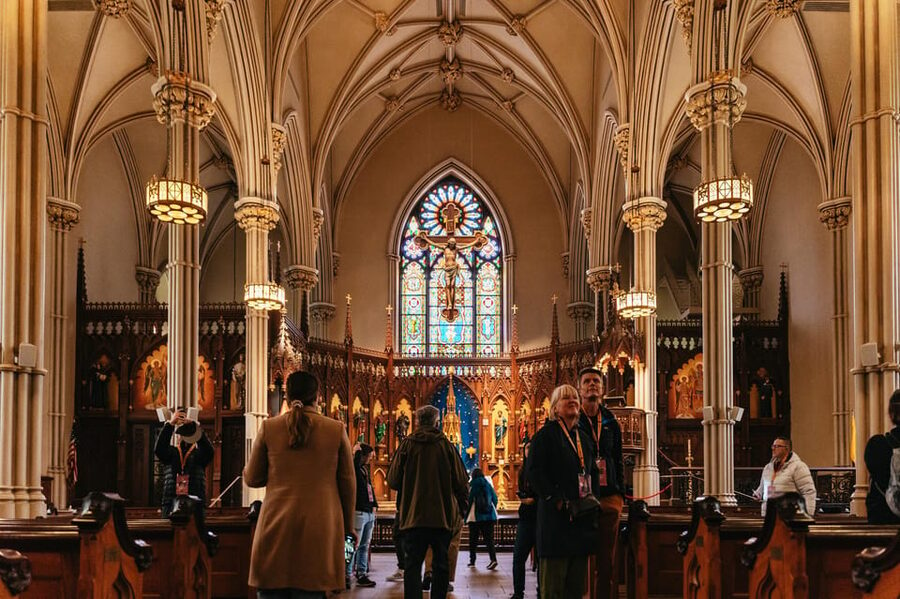
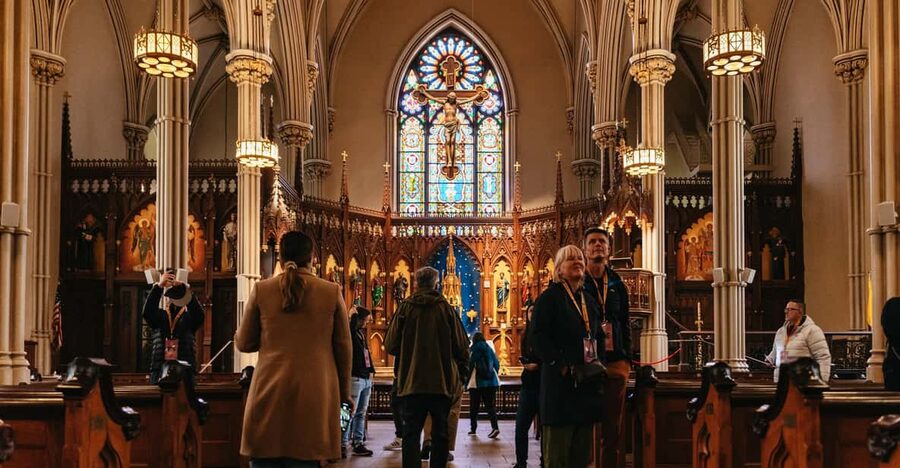
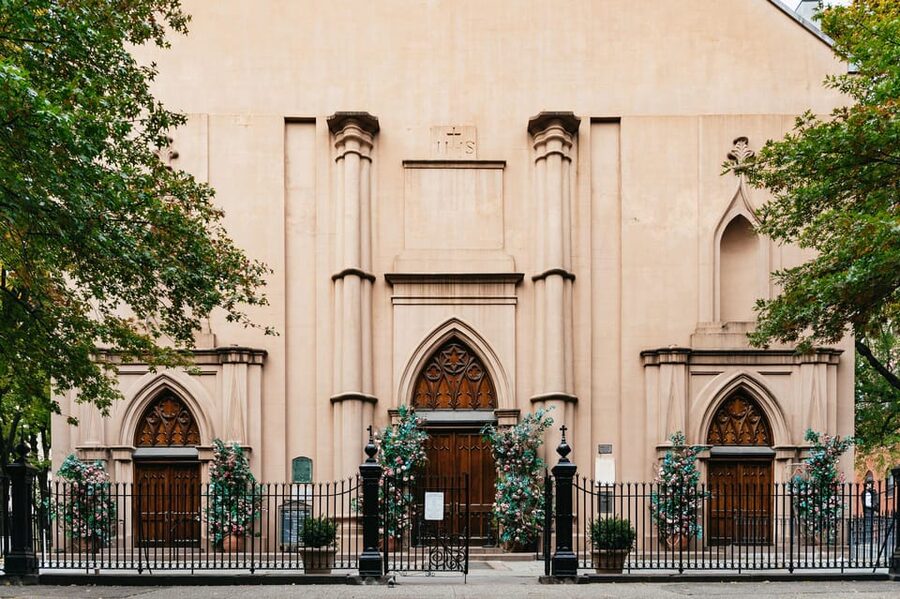
St. Patrick’s Old Cathedral sits on Mulberry Street, at the corner of Jersey Street, in a part of Manhattan better known for Little Italy restaurants and busy foot traffic. Inside, the pace changes. The church gives you a quiet place to look closely at New York’s Catholic past before you go below ground.
This is not the St. Patrick’s Cathedral on Fifth Avenue. That distinction matters. Check-in is at 266 Mulberry Street, at the Basilica of St. Patrick’s Old Cathedral. Give yourself enough time to find the correct church, especially if you are coming from another part of Midtown or Lower Manhattan.
The tour begins with the building and its setting. You learn how the land was acquired and how the church took shape during the early years of New York’s Catholic community. The story reaches beyond architecture. It includes religious tension, political change, Irish immigration, Italian neighborhoods, and the struggle to protect the church during periods of conflict.
I like this opening because it gives the catacombs a purpose. Without that context, a burial vault can feel like a curious old room. With it, you begin to understand who had enough standing, money, or church connection to receive a place beneath the basilica.
A few more New York City days worth weighing up
- NYC: SUMMIT One Vanderbilt Tickets
★ 4.7 · 51,195 reviews - NYC: 9/11 Memorial & Museum Timed-Entry Ticket
★ 4.8 · 31,428 reviews - NYC: Empire State Building Tickets – Observatory & Museum
★ 4.7 · 25,757 reviews
Inside the basilica, where New York stories begin
Your guide may spend a good portion of the first part of the tour inside the basilica and around its grounds. This is where guides such as Jimmy Boyle and Leo have been especially effective, bringing in local knowledge and small details that connect the church to the surrounding streets.
The architecture deserves attention, but this is not primarily an architectural tour. You are there to understand how a church became tied to the city’s growth. The building witnessed the rise of Catholic institutions and the arrival of communities that helped shape downtown Manhattan.
The guides often add personal energy to this section. Dan is known for a lively delivery and a knack for linking early American history with the political and religious climate of the period. Ronnie has been praised for making complicated stories easy to follow, including the tale of the bishopric. Other guides bring their own New York memories and neighborhood knowledge.
That variation is worth knowing. The subject remains the same, but the exact tone depends on who leads your group. You should expect an English-language tour with a human guide rather than a fixed audio presentation. That means you can ask questions, though the quality of the experience depends partly on the guide assigned that day.
Walking through the two walled cemeteries
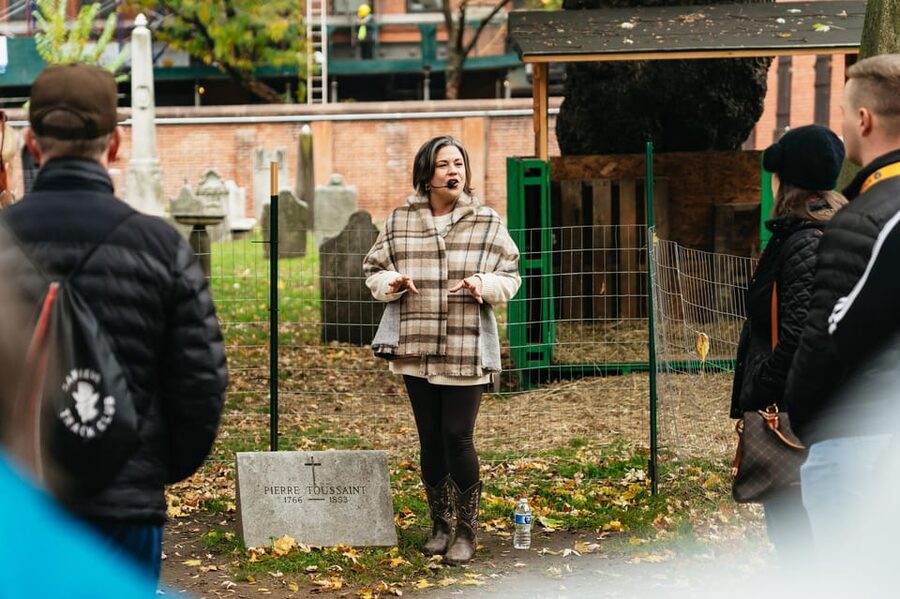
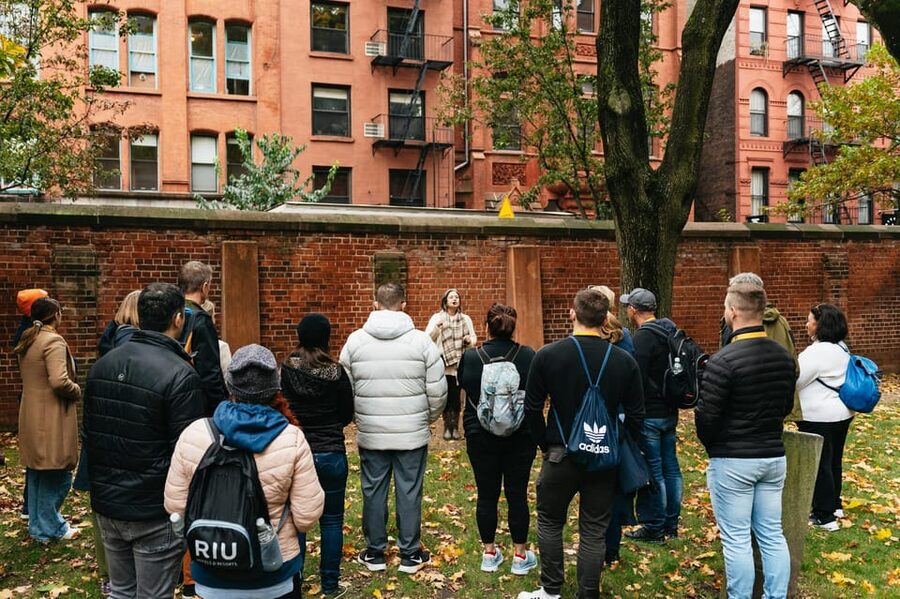
The tour then takes you into two walled cemeteries closed to ordinary public access. This is one of the strongest reasons to book. You are not simply looking at a church from the sidewalk. You are being taken into spaces that are normally off limits.
The cemeteries provide a different feel from the catacombs. Outdoors, you can take in the grounds and burial markers while your guide explains how the site developed. The walk also creates room for neighborhood stories, including the Irish and Italian tensions that shaped old New York.
Weather matters here. In good conditions, the cemetery portion can feel calm and spacious, and one guide may lead a longer stroll around the grounds. In rain, the experience still works, but you should arrive prepared. In winter, wear a warm layer. One practical tip from the tour experience is simple: dress for the weather even though part of the visit is indoors.
The cemeteries are not a grand park or an enormous burial complex. Their value comes from access and atmosphere. You get to see a protected piece of downtown history that is easy to miss from Mulberry Street.
Candlelight among the old burial vaults
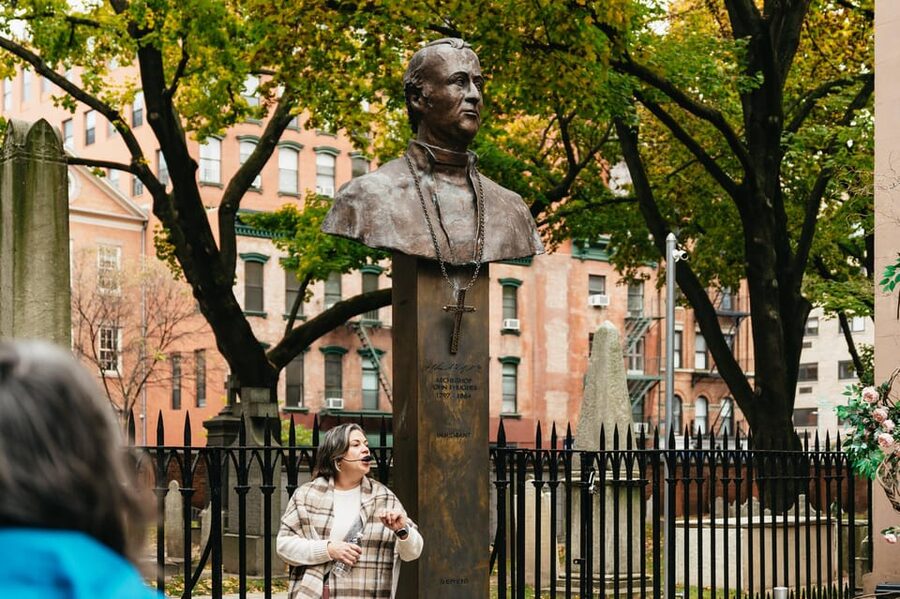
The final portion takes you below the church to the catacombs. Tea lights are included, and the candlelight helps set the tone without making the visit theatrical. You are seeing the only active Catholic catacombs in New York City, according to the tour information.
The catacombs contain vaults connected with bishops and prominent New York Catholics. Among the names associated with the site are Bishop John Connolly, the first resident Bishop of New York, members of the Delmonico family, and Civil War-era general Thomas Eckert.
The larger pattern is just as interesting. Many vaults belong to bankers, lawyers, captains of industry, merchants, and political candidates. This gives the catacombs a useful place in the city’s social story. Burial here was not only a private family matter. It reflected the importance of church, family, business, and public life in nineteenth-century New York.
Keep your expectations realistic. The catacombs are not a vast underground network with endless corridors. They are a compact group of historic vaults. One visitor felt the underground portion could have lasted longer, while another found the catacombs themselves less remarkable than the guide’s stories.
I think that is the right way to judge this part. If you want dramatic underground ruins, this may feel modest. If you like restricted historic spaces and the people connected to them, the visit offers something unusual for Manhattan.
A different sort of day out, same corner of New York City:
- NYC: Empire State Building Observation Deck Tickets
★ 4.7 · 22,072 reviews - NYC: Edge Observation Deck Admission Ticket
★ 4.6 · 20,918 reviews - New York City: Statue of Liberty & Ellis Island with Ferry
★ 4.6 · 18,683 reviews - New York City: American Museum of Natural History Ticket
★ 4.5 · 15,447 reviews
The guides shape the experience
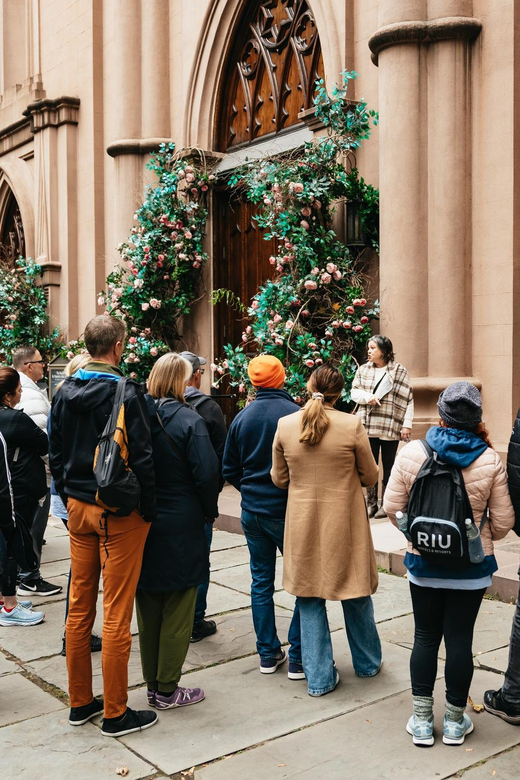
The strongest praise for this tour centers on the guides. Tony is described as patient, well informed, and closely connected with the cathedral. Leo is praised for giving New Yorkers details they had never heard before. Ronnie mixes historical information with humor, and Jimmy Boyle brings strong neighborhood knowledge and enthusiasm.
Dan is another memorable name. His style links church history with the wider political and religious world of early America, along with occasional references to films about the period. He is also praised for making the group feel involved rather than simply talking at them.
This matters because the catacombs alone do not provide a long list of things to see. Your guide supplies the meaning. A good guide explains why a bishop was important, how Catholic New York developed, and what the people in the vaults reveal about the city.
You should also feel free to ask questions. Several guides have been praised for answering patiently and for handling a mixed group with different levels of interest. The tone is usually serious enough for an active parish, but not stiff. Humor appears in the stories, not at the expense of the church.
The tour has also worked well for people who are not Catholic. You can appreciate the building, burial customs, neighborhood history, and immigrant story without sharing the faith. At the same time, anyone hoping for a purely secular ghost tour should choose another activity. This is a church-based historical visit, not a spooky entertainment show.
What the 90-minute schedule feels like
Ninety minutes is a sensible length for this experience. The tour has enough time to cover the basilica, two cemeteries, and catacombs, while remaining easy to fit before lunch or alongside other downtown plans.
The pace includes walking and standing. You will move between parts of the property, listen to stories, and go down one flight of stairs to the catacomb level. Comfortable shoes are a good idea, even though this is not a strenuous hike.
The schedule may feel quick if you are especially interested in church history or genealogy. One visitor wished for more time in the catacombs, and that is a fair concern. The tour has many subjects to cover, so the underground section cannot become a long independent exploration.
I see the short duration as a benefit for most visitors. You get a focused look at an unusual site without giving up half a day. If you want a slower study of every name and architectural detail, you may leave wanting more.
Is $38 a fair price?
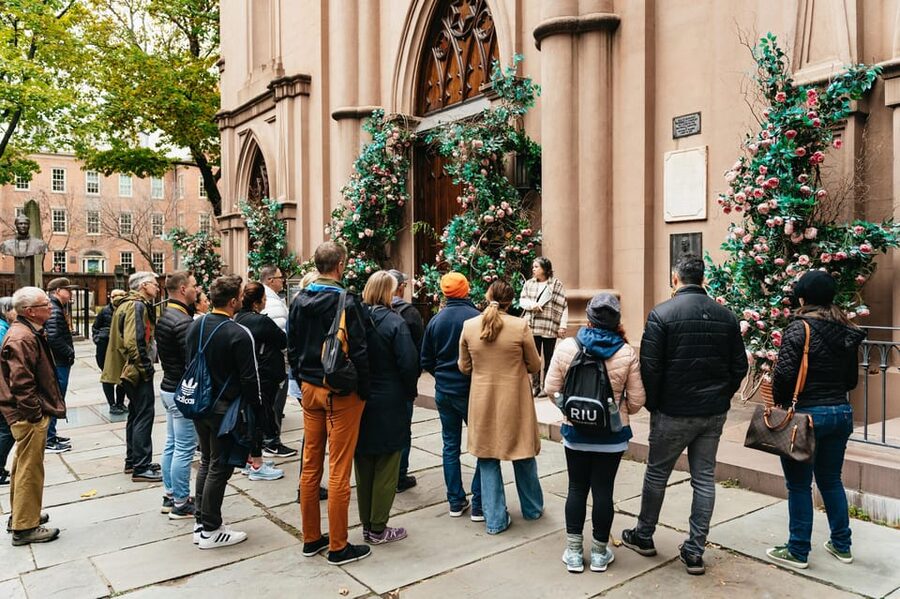
At $38 per person, the tour is priced above a basic church visit but below many longer New York attractions. You are paying for access, a live guide, and entry into areas you cannot normally visit on your own.
The value depends on what you care about. For someone interested in New York history, Catholic history, cemeteries, or old family names, the price is reasonable. The closed cemeteries and catacombs provide access that a free walk around the neighborhood cannot offer.
If your main goal is to see a large underground complex, the value is less certain. The catacombs are compact, and the visit’s appeal rests heavily on interpretation. You are paying for the stories behind the vaults as much as the vaults themselves.
Gratuities are not included, so bring cash if you want to thank your guide. Cash is also listed among the things to bring. Free cancellation is available up to two hours before the tour for a full refund, which gives you useful flexibility when your New York schedule changes.
Clothing, conduct, and access
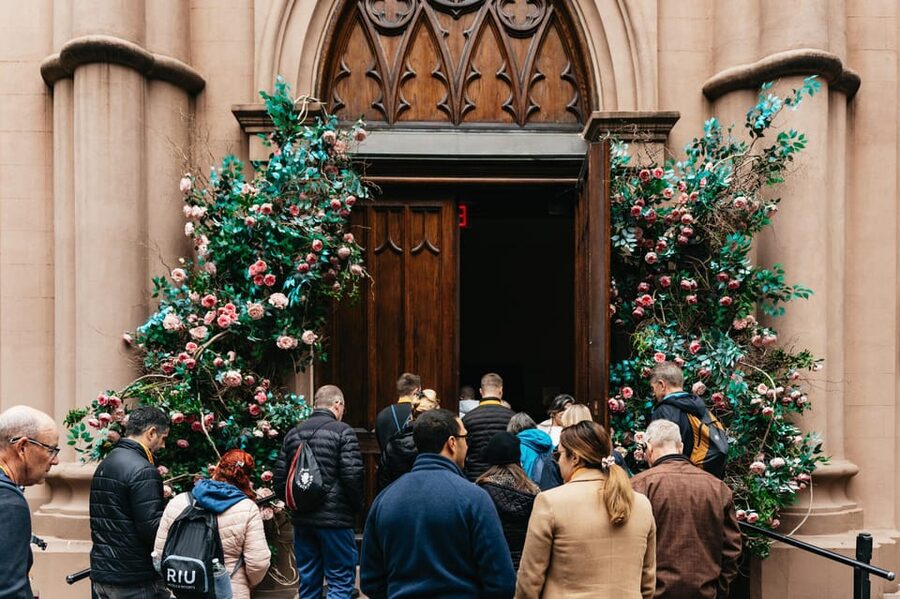
This is an active parish, not a museum that happens to contain a church. You need to behave reverently throughout the visit. Shorts and sleeveless shirts are not allowed, and video recording is prohibited.
Wear comfortable shoes and weather-appropriate clothing. The cemetery sections are outdoors, so a cold or wet day calls for proper layers. Tea lights are supplied, so you do not need to bring a candle.
The tour is not currently fully wheelchair accessible. There is one flight of stairs down to the catacomb level, and the activity is listed as unsuitable for wheelchair users and people over 80. The information also describes the activity as wheelchair accessible, so the practical detail is the one to trust: contact the operator before booking if mobility is a concern, because the catacomb stairs are part of the experience.
A parent or companion helping someone with a disability may find the staff accommodating, but you should not assume that the stairs can be avoided. This is one of the few serious limitations of the tour.
Who should book this Mulberry Street experience?
I would choose this tour if you enjoy local history with a strong sense of place. It is especially suitable for:
- People interested in Catholic history and historic churches
- Visitors tracing Irish, Italian, or New York family connections
- Fans of cemeteries, burial customs, and notable local figures
- Repeat visitors who want something beyond the usual Manhattan sights
- Anyone who prefers a guided story to a self-guided walk
- New York residents who want to understand the neighborhood more fully
I would be more cautious if you dislike religious sites, standing, stairs, or guided storytelling. The experience is not built around dramatic scenery or a large collection of objects. Its appeal comes from access, names, context, and the personality of the guide.
It also suits a rainy morning better than many outdoor plans, although the cemetery portions still require weather-ready clothing. The setting can feel especially atmospheric around Halloween, but the tour remains historical rather than fright-focused.
Should you book Catacombs by Candlelight?
Book it if you want a short, unusual look at old New York and you are happy to let a guide carry the story. The best parts are the two closed cemeteries, the chance to see the burial vaults, and the connection between the church and the city’s Irish, Italian, political, and commercial past.
Go in expecting a compact set of vaults, not an enormous underground maze. If that sounds fine, $38 buys access to a part of Manhattan most people never see, along with a guide who can make names and old walls feel relevant.
I would skip it only if stairs, religious settings, strict clothing rules, or a preference for large-scale attractions make the visit uncomfortable. For everyone else, it is a thoughtful 90-minute addition to a downtown itinerary, particularly when you want history that reaches beyond the main tourist routes.
FAQ
Where does the Catacombs by Candlelight tour meet?
Check in at 266 Mulberry Street, at the corner of Mulberry Street and Jersey Street. The tour takes place at the Basilica of St. Patrick’s Old Cathedral, not St. Patrick’s Cathedral on Fifth Avenue.
How long does the tour last?
The tour lasts 90 minutes.
What language is the tour conducted in?
The tour is conducted in English with a live guide.
Are the catacombs wheelchair accessible?
The tour is not currently fully wheelchair accessible because there is one flight of stairs down to the catacomb level. The activity is listed as unsuitable for wheelchair users.
What should I wear and bring?
Bring comfortable shoes, cash, and weather-appropriate clothing. Shorts and sleeveless shirts are not allowed. Tea light candles are provided.
Can I cancel for a refund?
Yes. You can cancel up to two hours in advance for a full refund.
Just added around New York City
- All Inclusive Airport Arrival Transfer to NYC/ Brooklyn/Queens★ 4.0 · 849 reviews
- The Big Apple Coaster at New York New York Hotel and Casino★ 5.0 · 982 reviews
- Mike Hammer Comedy Magic Show at the Four Queens Hotel★ 5.0 · 538 reviews
- Brooklyn Food Walking Tour: Local Eats & Family‑Run Shops★ 5.0 · 592 reviews
- All Inclusive Airport Departure Transfer NYC/ Brooklyn/Queens★ 4.0 · 342 reviews
- Brooklyn Bridge & DUMBO Food Tour: Local Eats & Landmarks★ 5.0 · 478 reviews
- West Harlem: Gospel Church Service and Sunday Walking Tour★ 4.3 · 411 reviews
- Harlem: Central Harlem Sunday Gospel with Locals★ 3.9 · 499 reviews
New York City Tours, compared.



Empire State Building Tickets – Observatory & Museum
Read our review →
Empire State Building Observation Deck Tickets
Read our review →


Browse the lists this tour appears in